|

Leaf Granny Square: Free Pattern with Step-by-Step Tutorial

Leaf Granny Square at a Glance

  • Topic: leaf granny square
  • Skill level: easy
  • Main goal: help the reader crochet a beautiful leaf motif with a Y-stitch technique and color-changing leaf design
  • Related topics: granny square patterns, leaf crochet motifs, nature granny squares, fall crochet projects

Quick Answer

A leaf granny square is a textured crochet motif that features a bi-color leaf applique worked with a special Y-stitch technique, set against a contrasting background with a central vein and stem detail. Tip: Master the dtr-dc Y-stitch by practicing on a swatch first — this special stitch is what gives the leaf its beautifully shaped outer contour.

At a Glance

  • Skill level: easy
  • Time needed: 30-45 minutes per motif
  • Best yarn: Weight 3 (DK/Light Worsted) wool or cotton for crisp stitch definition
  • Hook size: 3.00 mm (US C/2)

Common Mistakes to Quick Fixes

  • Leaf shape not forming correctly: Make sure you are working the dtr-dc Y-stitch into the 2nd level from the bottom of the dtr post — look for the 4 sets of parallel loops and work into the second set.
  • Color change showing gaps: Work the last stitch of the old color until the final yarn over, then yarn over with the new color and pull through all loops.
  • Borders not lying flat: Count your stitches carefully in the squaring round — 1 dc in each slst, 2dc+ch3+2dc in each ch-3 space, and 4 dc in each ch-4 space.

Mini Glossary

MR (Magic Ring), Sl.st (Slip Stitch), Ch (Chain), Sc (Single Crochet), Hdc (Half Double Crochet), Dc (Double Crochet), Tr (Treble Crochet), Dtr (Double Treble Crochet), Y-st (Y-Stitch), BLO (Back Loop Only), FLO (Front Loop Only)

If you have been exploring granny squares for any length of time, you already know that nature-inspired motifs are among the most rewarding projects a crocheter can tackle. The leaf granny square takes this idea to a new level by combining a realistic two-tone leaf appliqué with clever border construction, resulting in a motif that looks just as stunning on its own as it does joined into a larger afghan. Whether you are building a seasonal throw, decorating a fall table runner, or simply looking for a creative way to use up small scraps of green and yellow yarn, this leaf crochet square delivers visual impact without overwhelming complexity.

This pattern is rated easy, making it a wonderful next step for crocheters who are already comfortable with the fundamentals of crochet for beginners and are ready to try something with a bit more personality. The most exciting technique you will learn is the dtr-dc Y-stitch, a special stitch combination that builds the curved outer edge of the leaf quickly and cleanly. Once you understand how the Y-stitch works — and it is far simpler than it looks — you will find yourself looking for excuses to use it in other projects too. If you have never worked a granny square pattern before, do not worry; we walk you through every single round with clear, step-by-step instructions.

Before we dive into the written pattern, let us mention that this leaf granny square is part of a growing collection of botanical and nature-themed motifs here on Knot To Yarn. If you enjoy this design, you may also love the tulip granny square or the African flower granny square, both of which use creative stitch combinations to produce striking shapes. Browse our full library of free crochet patterns whenever you need fresh inspiration for your next project. Now, let us get started on your leaf granny square!

For further reading and pattern inspiration, we recommend visiting the Craft Yarn Council for standardized yarn weight and hook size references. You can also explore community-created variations of the leaf granny square on Ravelry, where crocheters from around the world share their own colorways and modifications.

What Makes the Leaf Granny Square Special

At first glance, the leaf granny square looks like an ordinary crochet square with a leaf stitched on top — but that assumption misses what makes this motif truly clever. Unlike most appliqué-style squares where a motif is made separately and sewn on, the leaf in this pattern is crocheted directly into the border structure. The chain loops that form the border base double as attachment points for the leaf stitches, so everything becomes one cohesive piece. This approach eliminates the tedious sewing step and creates a much neater finished product where the leaf appears to grow organically from the square itself.

The real star of the show is the Y-stitch technique. In a traditional leaf motif, you might use a series of increasing double crochet or treble crochet stitches to shape each side of the leaf. That works, but it produces a somewhat angular, stepped edge. The dtr-dc Y-stitch used in this leaf granny square creates a smooth, flowing curve because each Y-stitch spans the height of two regular stitches. The result is a leaf that looks hand-painted rather than pixelated — a level of refinement that elevates the entire granny square from craft to art.

Another feature that sets this crochet leaf square apart is the surface slip stitch detail work. After the square is fully formed, a midrib (the central vein of the leaf) and a short stem are added using brown yarn worked over the surface of the existing stitches. This finishing touch adds depth and realism without any extra bulk. If you have ever struggled with a crooked granny square, you will appreciate how the border rounds in this pattern are carefully calibrated to keep everything square and flat. The finished leaf granny square measures approximately 3.35 by 3.35 inches, making it a versatile size for blankets, pillows, and seasonal décor.

Materials and Tools

Gathering the right supplies before you begin will make the entire process smoother and more enjoyable. Here is everything you need to complete one leaf granny square:

  • Yarn — 3 colors: One skein or partial skein each of yellow (for the leaf’s highlight color), green (for the leaf’s main body), and brown (for the midrib and stem). A well-balanced crochet tension is easier to achieve with a smooth, plied yarn, so opt for a quality wool or cotton blend rather than a fuzzy or novelty yarn. Weight 3 (DK/Light Worsted) is ideal because it provides excellent stitch definition for the Y-stitch details while keeping the finished square at a manageable size.
  • Crochet hook — 3.00 mm (US C/2): This smaller hook size creates tight, neat stitches that really show off the leaf shape. If you are unsure which hook brand to choose, our guide to the best crochet hooks for beginners covers several ergonomic options that are comfortable for extended stitching sessions. You may also want to review our crochet hook sizes chart to understand how millimeter sizing translates to US and UK letter/number systems.
  • Scissors and yarn needle: For trimming ends and weaving in the color-change tails that occur during the leaf construction.
  • Stitch marker (optional): Helpful for marking the first stitch of each round if you tend to lose your place. Not strictly required, but a nice safety net.

One quick note on yarn substitution: if you prefer a larger or smaller leaf granny square, you can adjust the size by changing your yarn weight and hook size proportionally. Moving up to a 4.00 mm hook with worsted weight yarn will produce a square closer to 4.5 inches, while dropping down to a 2.50 mm hook with fingering weight yarn will give you a dainty 2.5-inch motif. Just remember that the stitch counts in the pattern remain the same regardless of your yarn and hook choices. For more on adapting patterns, see our how to read a crochet pattern guide.

Stitch Abbreviations (US Terminology)

This leaf granny square pattern uses standard US crochet terminology. If you are accustomed to UK terms, be aware that what Americans call a “double crochet” (dc) is the UK “treble crochet,” and what Americans call a “single crochet” (sc) is the UK “double crochet.” For a comprehensive conversion reference, check out our crochet abbreviations for beginners guide. Below is the full list of abbreviations used in this pattern:

  • MR — Magic Ring (also called a magic circle). If you need a refresher, our magic circle crochet guide walks you through two different methods.
  • Ch — Chain
  • Sl.st — Slip Stitch
  • Sc — Single Crochet
  • Hdc — Half Double Crochet. Review the basics in our half double crochet tutorial.
  • Dc — Double Crochet. This is the workhorse stitch of the pattern. See our double crochet stitch tutorial if you need a refresher.
  • Tr — Treble Crochet
  • Dtr — Double Treble Crochet
  • Y-st — Y-Stitch (special stitch explained in detail below)
  • BLO — Back Loop Only
  • FLO — Front Loop Only

Understanding these abbreviations will make it much easier to read crochet patterns of all kinds, not just this leaf granny square. Keep this list handy as you work through the rounds — especially the Y-stitch, which is unique to this design.

Special Stitch: The Y-Stitch (Y-st)

The Y-stitch is the defining technique of this leaf granny square, and understanding it thoroughly will make the entire pattern click into place. A Y-stitch (abbreviated Y-st) is formed by working a tall stitch — in this case, a double treble crochet (dtr) — and then, instead of simply moving on to the next stitch, you work a shorter stitch (a double crochet, dc) into the post of that dtr. The two stitches share a base at the bottom and diverge at the top, creating a shape that resembles the letter Y when viewed from the side.

Here is exactly how to execute the dtr-dc Y-stitch used throughout the leaf portion of this pattern:

  1. Yarn over three times and insert your hook into the designated stitch or chain space.
  2. Yarn over and pull through — you now have 5 loops on your hook.
  3. Yarn over and pull through two loops four times in succession. After this sequence, you have completed one dtr. Do not cut the yarn or remove the hook.
  4. Now look at the post of the dtr you just made. You will see four sets of parallel loops running horizontally along the post (one set for each “yarn over and pull through two” step). Starting from the bottom of the post, count up to the second set of loops.
  5. Insert your hook under the strands of that second set, yarn over, and pull through (2 loops on hook).
  6. Yarn over and pull through two loops once more. You have now completed a dc worked into the post of the dtr, forming the Y-stitch.

Practice this on a plain swatch before starting your leaf granny square if you are at all uncertain. Make a chain of 15 stitches, work a row of dc into the chain, and then try working a few Y-stitches along that row. Pay close attention to finding that second set of loops — this is the most common stumbling point for crocheters new to the technique. Once your practice Y-stitches look even and symmetrical, you are ready to tackle the leaf motif with confidence. The Y-stitch is what gives the leaf granny square its distinctive curved edge, and mastering it will open the door to countless other creative stitch combinations.

How to Change Colors

This leaf granny square uses three colors, which means you will be changing yarn at several points during the leaf construction. Clean color changes are essential for a polished look, and fortunately, the technique is straightforward once you know the right moment to introduce the new yarn.

To change colors cleanly in this crochet leaf square, follow these steps every time you switch from one color to the next:

  1. Work the last stitch of the old color as you normally would, stopping at the final yarn over. For example, if the last stitch is a dc, you would yarn over, insert the hook, yarn over, pull through, yarn over, pull through two loops, and then stop — leaving two loops on your hook.
  2. Drop the old color and yarn over with the new color.
  3. Pull through both remaining loops with the new color. This completes the stitch and locks the new color in place.
  4. Continue working with the new color. Do not cut the old color unless the pattern specifically tells you to — you may need it again in a few stitches.
  5. When the pattern calls for you to return to a previously dropped color, simply pick it back up, leaving a small loop of slack to prevent puckering, and resume stitching.

As you work across the leaf, lay the unused yarn tail over the previous stitches and crochet over it. This technique, sometimes called “crocheting over tails,” secures the color change without the need to weave in ends later. It is especially useful in the leaf granny square because the color changes happen frequently along both sides of the leaf. If you notice gaps or loose stitches at your color-change points, try tightening your tension slightly on the stitch immediately before and after the change. Proper crochet tension is key to a tidy result.

Leaf Granny Square Pattern — Step by Step

Now let us walk through the leaf granny square pattern round by round. The construction is divided into five distinct phases: the leaf appliqué, the border base, squaring, the second border, and the final midrib and stem. Work through each phase carefully, and do not hesitate to rip back and redo a section if something does not look right — that is part of the learning process.

The Leaf Appliqué

The leaf is the heart of this leaf granny square, and it is worked first as a standalone motif that will later be enclosed by the border rounds. You will use two colors for the leaf: yellow for the center highlight and green for the outer body.

With yellow yarn, chain 11. This chain forms the central spine of the leaf and serves as the foundation for all the stitches on both sides. Working from the hook end toward the slip knot, you will now build the leaf by working stitches into the chain on both sides.

Starting in the 4th chain from the hook, work 1 dc. Then work 1 tr in each of the next 2 chains. At this point, you have established the base stitches along one side of the leaf’s upper half.

Now it is time for the first Y-stitch: work 1 dtr-dc Y-st in the next chain, remembering to find the second set of loops on the dtr post and work your dc into that spot. This Y-stitch begins the curved outer tip of the leaf.

Work 1 tr in the next chain, then 1 dc in the next chain. You have now reached the center of the chain — the tip of the leaf. Change to green yarn on the last yarn over of that dc.

Now you will mirror the stitches down the other side of the chain. Work 1 dc in the next chain (working back toward the starting end), then 1 tr in the next, then 1 dtr-dc Y-st in the next. Work 1 tr in each of the next 2 chains, and finally 1 dc in the last chain — which brings you back to the base of the original chain-11.

Fasten off. Your leaf appliqué is complete! It should look like an elongated oval with a visible two-tone transition where the yellow center gives way to the green outer edges. If your leaf looks asymmetrical, compare the stitch counts on each side — they should mirror each other exactly. This leaf will now be surrounded by the border rounds that turn it into a proper leaf granny square.

Border Base

The border base round creates a framework of chain loops all the way around the leaf appliqué. These loops serve a dual purpose: they establish the stitch count for the squaring round, and they provide the anchor points for the second border. This round is worked with the same green yarn (or a background color of your choice).

Join your green (or background color) yarn with a slip stitch anywhere along the outer edge of the leaf. Now work your way around the entire perimeter, placing chain-3 loops along the straighter sides of the leaf and chain-4 loops at the more curved sections (the tip and the base). The exact distribution will depend on how tightly or loosely you crochet, but aim for approximately 24-28 total chain spaces around the entire leaf.

For the straight portions of each leaf side, work approximately 1 chain-3 loop for every 2 stitches of the leaf edge. At the top tip and the bottom base of the leaf, where the curvature is greatest, work chain-4 loops to compensate for the extra distance. Join with a slip stitch to the first chain of the round and fasten off.

Take a moment to lay your work flat and check that the chain loops are evenly spaced. Uneven loops will cause the squaring round to ruffle or cup, so it is worth spending an extra minute here to get the spacing right. This attention to detail is what separates a good leaf granny square from a great one.

Squaring

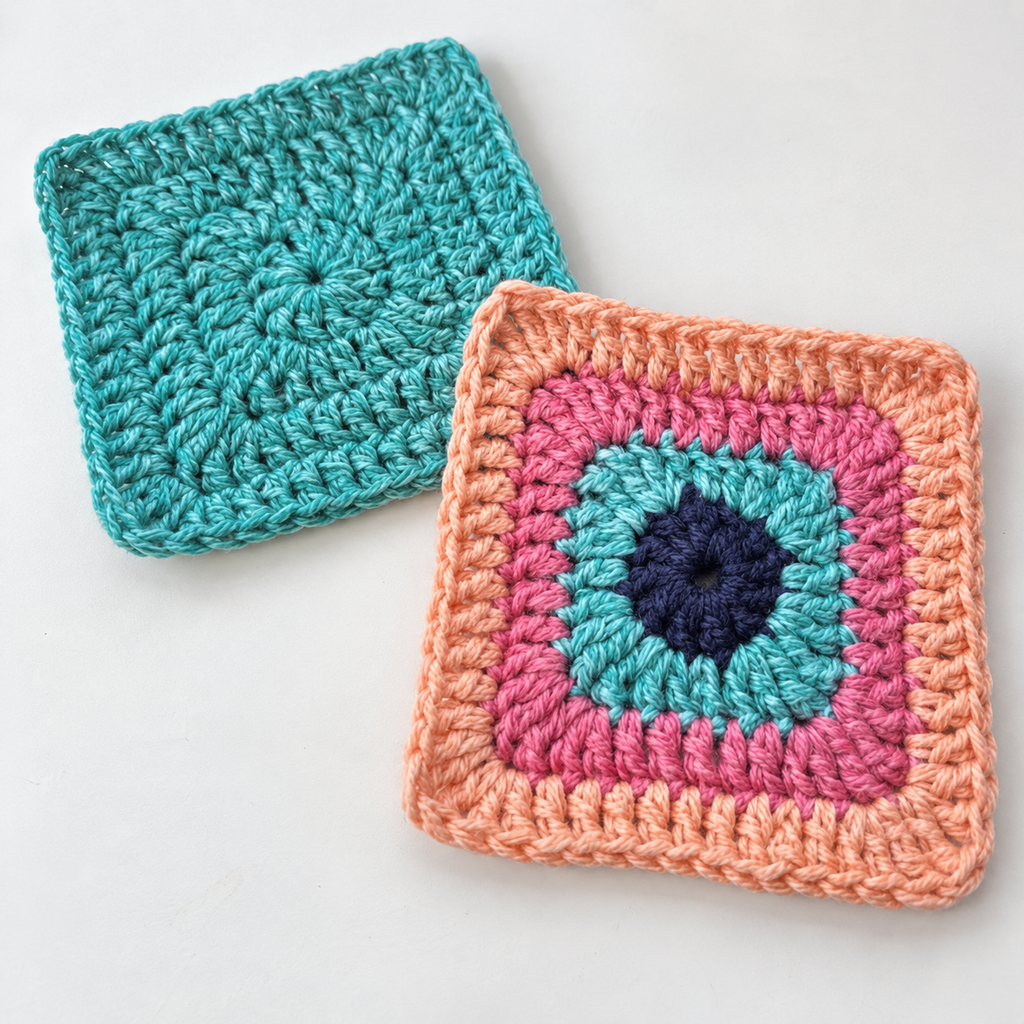
This is the round where your circular border base transforms into a proper square shape. The squaring round uses double crochet stitches worked evenly around the chain loops, with special corner treatments to create the 90-degree angles. If you have ever made a solid granny square pattern, the corner concept will feel familiar — but the stitch distribution is adapted to fit the chain-loop structure of this leaf granny square.

Round — Squaring: Join your background color yarn with a slip stitch in any chain-3 space. Work 1 dc in each slip stitch along the border base. When you reach a chain-3 space, work the standard corner sequence: 2 dc, chain 3, 2 dc all in the same space. When you reach a chain-4 space, work 4 dc evenly spaced in the chain to maintain the correct stitch count.

Repeat this around all four sides. You should have four corners, each with a 2dc-ch3-2dc sequence, and straight sides filled with 1 dc per stitch. Join with a slip stitch to the first dc of the round.

Critical check: Count your stitches on each side. They should be equal (or within 1 stitch of equal) for the square to lie flat. If one side has noticeably more stitches than the others, your leaf granny square will not join neatly with other squares in a blanket. This is also the round where tension issues tend to show up most clearly, so keep an eye on your gauge as you work.

The Second Border

The second border round adds stability and definition to the leaf granny square, bringing the overall size to its finished measurement of approximately 3.35 by 3.35 inches. This round is simple and rhythmic, making it a satisfying finish after the concentration required for the leaf and squaring rounds.

Round — Second Border: Join your background color (or a contrasting color for visual pop) with a slip stitch in any stitch. Work 1 dc in each dc around the entire square. At each corner — the chain-3 space from the squaring round — work the same corner treatment: 2 dc, chain 3, 2 dc in the corner space.

Join with a slip stitch to the first dc of the round and fasten off. This round should feel effortless and relaxing. The leaf granny square now has a clean, finished border that frames the leaf motif beautifully. If you want a larger square, you can repeat this border round with an additional dc-in-each-dc round and corners, which will add roughly half an inch to each side. The granny square crochet pattern tradition often includes multiple border rounds, so feel free to customize.

Adding the Midrib and Stem

The final phase of this leaf granny square is the surface detail work that brings the leaf to life. You will add a midrib (the central vein running down the middle of the leaf) and a short stem at the base — both worked in brown yarn using the surface slip stitch technique.

Midrib: Thread a length of brown yarn onto your yarn needle (or, if you prefer to work with your hook, join the brown yarn with a slip stitch at the base of the leaf). Working from the base to the tip along the center chain of the leaf, insert your hook under the top loop of each stitch in the central chain and pull a loop of brown yarn through. Insert your hook under the next stitch and pull through both loops on your hook. Continue this surface slip stitch all the way to the tip of the leaf. This creates a raised line of brown stitches that mimics the natural midrib of a real leaf.

Stem: At the base of the leaf, where the midrib ends, chain 4 with the brown yarn. Work 1 slip stitch in the 2nd chain from the hook and in each remaining chain to create a small, tapered stem. Fasten off and weave in the end.

These two small details make an enormous difference in the finished appearance of the leaf granny square. The midrib gives the leaf structure and dimensionality, while the stem grounds it visually and makes the motif read unmistakably as “leaf” rather than an abstract shape. Admire your finished leaf granny square — you have just completed a project that combines appliqué construction, special stitches, color changes, and surface embellishment all in one compact motif!

Color Ideas for Your Leaf Granny Square

One of the most enjoyable aspects of making this leaf granny square is experimenting with color combinations. The original pattern calls for yellow, green, and brown — a classic autumnal palette that evokes changing foliage. But the design is versatile enough to look stunning in many different colorways. Here are several palette suggestions to spark your creativity:

  • Spring green: Lime green leaf body with white center highlight and a dark forest green midrib. Pair this with a cream or white background for a fresh, bright look that would be perfect for a spring table setting or baby blanket.
  • Autumn warmth: Burnt orange leaf body with golden yellow center and chocolate brown midrib. Use a warm cream or tan background to keep the cozy fall feeling. This is the original inspiration for the leaf granny square and remains the most popular choice.
  • Tropical: Teal or turquoise leaf body with hot pink center highlight and deep purple midrib. A white or light gray background keeps the colors from overwhelming the design. This bold combination would make a striking pillow cover or tote bag panel.
  • Monochromatic green: Use three shades of green — light sage for the center, medium green for the body, and dark olive for the midrib and stem — against a soft ivory background. This tonal approach is subtle and sophisticated, perfect for elegant home décor projects.
  • Holiday red: Deep red leaf body with cream center and dark brown midrib, set against a dark green background. This colorway transforms the leaf motif into something that looks like a holly leaf or holiday ornament, ideal for winter-themed projects and Christmas gifts.

Do not be afraid to try colors outside your comfort zone. The leaf granny square is a small, quick project — if a color combination does not work out, you have only invested 30 to 45 minutes. Keep notes on which yarns you used for each square so you can replicate successful combinations later. If you are planning a large multi-square project, consider making a few test squares in different colorways before committing to a full blanket’s worth of yarn.

Project Ideas Using the Leaf Granny Square

A single leaf granny square is satisfying on its own, but the real magic happens when you start combining multiple motifs into larger projects. Here are some of our favorite ways to use this versatile pattern:

Seasonal throw blanket: Make 49 leaf granny squares (a 7×7 grid) in autumn colors and join them with a seamless join-as-you-go method or a decorative border. The repeating leaf motif creates a stunning visual rhythm across the blanket surface, and the small size of each square means you can easily customize the color placement — perhaps arranging the squares in a gradient from yellow-green at one corner to deep forest green at the opposite corner. For joining tips, our granny square pattern guide covers several popular techniques.

Fall table runner: Make 9 to 12 leaf granny squares and arrange them in a single row or a 2×5 grid. Add a simple single-crochet border in a coordinating solid color, and you have a beautiful table runner that celebrates the harvest season. This project is relatively quick and makes a wonderful handmade housewarming or hostess gift.

Cushion covers: Just 4 leaf granny squares joined in a 2×2 arrangement create a 6.5-inch panel — add a border round or two to bring it up to standard cushion size. Mix and match different colorways for a patchwork effect, or keep all four squares identical for a clean, unified look.

Market bag panels: Crochet a rectangular panel of 3×6 leaf granny squares, fold it in half, seam the sides, and add handles for a unique market tote. The textured leaf pattern adds visual interest to an otherwise simple bag shape, and the cotton yarn holds up well to daily use.

Wall art: Mount individual leaf granny squares in embroidery hoops or shadow boxes for a nature-inspired gallery wall. Use different colorways for each square to create a collection that showcases the versatility of the design. This is an excellent project for using up small yarn scraps and would make a lovely gift for a nature-loving friend.

If you enjoy botanical-themed granny squares, be sure to explore other nature motifs in our collection. The tulip granny square pairs beautifully with this leaf design in spring-themed projects, while the African flower granny square adds a geometric contrast that works well in mixed-motif blankets. For even more variety, the 3D flower granny square free pattern and the hexagon granny square pattern offer completely different shapes that can be combined with leaf squares for truly unique creations.

Frequently Asked Questions

What is a Y-stitch in crochet?

A Y-stitch (Y-st) is a special crochet stitch that creates a wider, more open stitch by combining a taller stitch with a shorter one worked into the post of the first. In the leaf granny square, the dtr-dc Y-stitch is used to build the leaf’s curved outer edge quickly. The taller dtr provides height while the dc worked into its post adds width, and together they form a shape that builds the leaf contour in fewer stitches than traditional increasing methods. Once you understand how to locate the second set of loops on the dtr post, the Y-stitch becomes a fast and intuitive technique.

How do I change colors cleanly in the leaf granny square?

Work the last stitch of the old color until the final yarn over. Yarn over with the new color and pull through all remaining loops. Lay the yarn tails over the previous stitches and work over them to secure. This method, which is used throughout the leaf portion of this crochet leaf square, produces nearly invisible transitions between colors. The key is to always change on the very last yarn over of a stitch — changing too early leaves a visible dot of the old color, and changing too late creates a gap where neither color covers the stitch.

Can I make the leaf granny square bigger?

Yes. You can add more rounds to the border or use a larger hook and thicker yarn. Each additional dc border round with standard 2dc-ch3-2dc corners adds roughly 0.5 inches to the square’s dimensions. You can also place two or more leaf granny square motifs side by side within a single large square framework for a compound design. If you want to scale up significantly, try using worsted weight yarn with a 5.00 mm hook — the pattern works exactly the same way, and your finished square will be closer to 5 inches across.

What yarn is best for a leaf granny square?

Weight 3 (DK/Light Worsted) wool or cotton yarn works best. Wool gives excellent stitch definition for the Y-stitch details, while cotton holds its shape well for the border. Avoid fuzzy or textured yarns like mohair or bouclé, because the novelty texture obscures the precise stitch work that makes the leaf granny square so visually appealing. Smooth, tightly plied yarns in saturated colors will give you the cleanest, most professional-looking results.

Is the leaf granny square suitable for beginners?

Yes, it is rated easy. If you are comfortable with basic stitches like dc and tr, and can follow a color change, you can make this pattern. The Y-stitch is explained step by step, and once you have practiced it on a swatch, you will find it straightforward to apply within the leaf granny square context. We recommend that absolute beginners first complete a few simple granny square patterns to build confidence with tension, stitch counting, and round construction before tackling the leaf motif. The solid granny square pattern is an excellent starter project that teaches the corner technique used in this pattern.

Similar Posts

Leave a Reply

Your email address will not be published. Required fields are marked *