Granny Square Dog Sweater: 7 Ideas + a Free Small-Dog Pattern

Granny Square Dog Sweater: 7 Ideas + a Free Small-Dog Pattern

Granny Square Dog Sweater: 7 Ideas + a Free Small-Dog Pattern

Quick Answer

A granny square dog sweater is a crochet garment made by joining individual granny squares into panels that wrap around your pup’s body. The modular construction makes it incredibly easy to customize for tiny Chihuahuas or large Golden Retrievers, and you can adjust the length simply by adding or removing rows of squares.

Tip: Always measure your dog’s chest circumference, neck size, and back length before starting any granny square dog sweater project.

At a Glance

  • Skill level: beginner to intermediate
  • Time needed: 4-10 hours (depending on size and pattern)
  • Best yarn: medium worsted acrylic or cotton blend (check our best yarn for beginner crochet guide)
  • Hook size: 5.0 mm (H) to 6.5 mm (K)

Common Mistakes → Quick Fixes

  • Sweater is too tight: Add an extra granny square to each panel and re-measure before joining
  • Squares curl at the edges: Block each square flat, learn about why crochet curls, before assembling your granny square dog sweater
  • Neck opening is too small: Chain extra stitches at the neckline and work additional rounds of single crochet for a comfortable fit

Mini Glossary

GS (granny square), SC (single crochet), DC (double crochet), CH (chain), FO (fasten off), SL ST (slip stitch), BLO (back loop only), PM (place marker), sp (space)

This is KnotToYarn’s own original pattern, free to use, and you’re welcome to sell what you make from it.

A small-dog sweater is a rectangle with strategic holes, and granny fabric stretches enough to dress a wriggling chihuahua. This formula fits dogs roughly 25-35 cm around the chest; measure first, always.

Materials

  • Worsted weight acrylic or superwash wool, about 100 g (machine-washable matters, dogs are dogs)
  • 5.0 mm (US H) crochet hook
  • Measuring tape, stitch markers, yarn needle

Finished size: Custom from 3 dog measurements: chest girth (behind front legs), neck girth, back length (collar to tail base)
Skill level: Confident beginner
Abbreviations (US terms): ch (chain), sc (single crochet), dc (double crochet), sl st (slip stitch), sp (space), cluster (3 dc in one space)

Instructions

Measure the Dog

Chest girth right behind the front legs, neck where the collar sits, and back length from collar to tail base. Write them down, dog sweaters fail by guesswork.

The Body (a granny rectangle)

Ch a foundation about as long as the dog’s BACK LENGTH minus 5 cm. Work the granny-rectangle setup: 3 dc in the 5th ch, *skip 2, 3 dc;* to the end, (3 dc, ch 2, 3 dc, ch 2, 3 dc) in the last ch, back along the other side, (3 dc, ch 2, 3 dc, ch 2) at the start end, join.

Work granny rounds, (3 dc, ch 2, 3 dc) in the 4 corners, 3 dc in side spaces, until the rectangle’s WIDTH equals the chest girth plus 2 cm. Usually only 3-5 rounds for a small dog.

Shaping by Folding

Fold the rectangle in half lengthwise (a long tube around the dog’s body). Seam the chest/belly edge: from the NECK end, seam the first 5 cm. Leave a 4-5 cm gap (front leg one), seam 3 cm, leave another 4-5 cm gap (front leg two), then seam until the belly section ends, for a male dog, stop the belly seam earlier; you will see why on the first walk.

Try it ON THE DOG before fastening off any seam. Adjust gap positions to the actual legs in front of you.

The Neck and Hem Ribbing

Neck: join yarn at the neck opening, work rounds of sc until the collar is snug but slips over the head, 3-5 rounds. Hem and leg holes: 1-2 rounds of sc each so nothing stretches out.

Finishing

Weave ends in extra well, claws find loose ends with supernatural accuracy. Machine wash cold, dry flat. If the sweater slides sideways when the dog runs, add a 3 cm wide sc belly strap between the leg holes with a button.

Made this? We’d love to show off your work, send a photo through our contact page and we’ll feature it here with credit to you.

Tip: Dogs tolerate snug; they hate baggy (it catches on everything). When between sizes, size DOWN, granny fabric gives 10-15 percent.

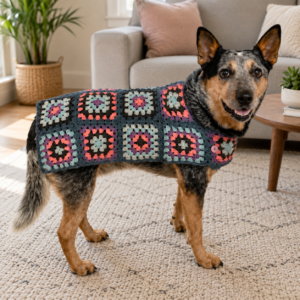
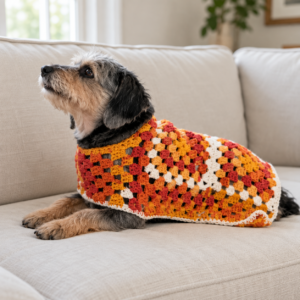
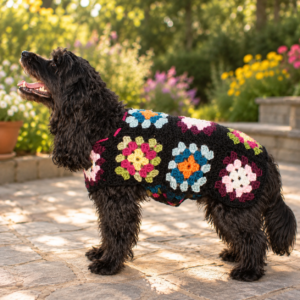
Crocheting a granny square dog sweater is one of the most rewarding projects for a pet-loving crafter, pair one with an easy beanie for a complete handmade gift set. These cozy garments keep your pup warm on chilly walks, and the modular granny square build lets you customize everything, from the color palette to the exact measurements. This guide has 7 free patterns that work for every breed, from teacup pups to gentle giants.

Why Choose a motif?

The granny square dog sweater stands out from other pet apparel for a few practical reasons. First, granny squares are one of the most versatile building blocks in crochet. Once you’ve got the basic technique, clusters of double crochet worked into chain spaces, you can make panels of any size. That modularity is ideal for dog clothes, since every breed is shaped differently: a Dachshund needs a long, narrow panel while a Bulldog needs a wider, shorter chest. Adjust the number of squares per row and it fits perfectly.

It’s also portable. You can crochet individual squares on the go, on your commute, in a waiting room, in front of the TV, then join them at home. That keeps the project from feeling overwhelming, even in a larger size, and it uses simple stitches, so it’s approachable even if you’re still learning how to read a pattern.

According to the Craft Yarn Council, granny squares remain one of the most popular motifs among crocheters of all levels, making them an excellent choice for your next pet project.

Dog Sweater Size Chart

Before you begin any granny square dog sweater pattern, accurate measurements are essential. Use a soft measuring tape and record these three key dimensions while your dog is standing:

  • Neck girth: Measure around the base of the neck where a collar sits naturally.
  • Chest girth: Measure around the widest part of the ribcage, just behind the front legs.
  • Back length: Measure from the base of the neck (between the shoulder blades) to the base of the tail.

General Size Guidelines

  • Extra Small (XS): Neck 8-10″, Chest 12-14″, Back 8-10″, suitable for Chihuahuas, Yorkies, Maltese
  • Small (S): Neck 10-12″, Chest 14-18″, Back 10-12″, suitable for French Bulldogs, Pugs, Shih Tzus
  • Medium (M): Neck 14-16″, Chest 20-24″, Back 14-16″, suitable for Beagles, Corgis, Australian Shepherds
  • Large (L): Neck 16-20″, Chest 26-30″, Back 18-22″, suitable for Labrador Retrievers, Golden Retrievers, Boxers
  • Extra Large (XL): Neck 20-24″, Chest 30-36″, Back 22-26″, suitable for Great Danes, Mastiffs, Saint Bernards

These measurements tell you how many granny squares you need for each panel. A typical 4-inch square works well as a base unit, just divide your dog’s measurements by 4 to estimate squares per row.

7 Free Granny Square Dog Sweater Patterns

Below are seven free patterns organized by style and difficulty. Each one can be adapted to any breed size using the chart above.

Pattern 1: Classic Two-Panel Cardigan

This is the most straightforward granny square dog sweater design. You crochet two rectangular panels (a chest panel and a back panel) made up of joined granny squares, then seam them together along the top of the back and under the belly. Leave openings for the front legs and neck. Use 2 to 3 rows of squares for small dogs and 4 to 5 rows for large breeds. This cardigan style buttons along the chest, making it easy to put on and take off.

Pattern 2: Vest-Style Granny Square Sweater

A vest-style sweater suits mild weather. It covers the back and chest but leaves the legs free, which is ideal for active dogs. Crochet a single large panel for the back and two smaller side panels, then join them at the underbelly. If you want a printable version with detailed schematics, be sure to download our Cardigan/Vest PDF pattern for complete step-by-step instructions.

Pattern 3: Colorblock Stripe Sweater

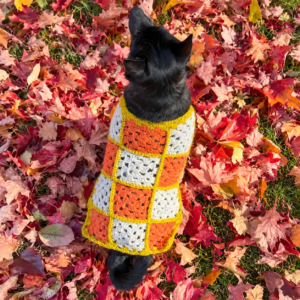
Use alternating solid-color granny squares to create bold, eye-catching stripes on your sweater. For example, alternate between navy blue and mustard yellow squares for a classic look, or try a rainbow progression for something playful. The construction is the same as the classic two-panel cardigan, but the visual impact is much stronger. This pattern is a great way to use up leftover yarn from other projects.

Pattern 4: Granny Square Hoodie

Add a hood to your sweater for extra warmth and an adorable look. Start with the standard two-panel construction, then crochet a small semi-circular hood piece using half-granny squares or decreasing clusters. Attach it to the neck opening. This pattern is especially popular for small breeds like Pomeranians and French Bulldogs.

Pattern 5: Turtleneck Granny Pullover

A turtleneck sweater adds a cozy, snug layer around the neck. After assembling the main body panels, work several rounds of single crochet around the neck opening to create a stand-up collar. This style is excellent for short-haired breeds that get cold easily, such as Greyhounds and Whippets. The tall collar provides extra protection against wind and chill.

Pattern 6: Granny Square Leggings Harness Cutout

Many dog owners use harnesses instead of collars, so this granny square dog sweater pattern includes a built-in harness cutout on the back. Crochet the panels as usual, but when joining the back seam, leave a 2-inch gap at the top center and work a reinforced border around the opening. This functional design has become one of the most requested patterns in the pet crochet community.

Pattern 7: Holiday-Themed Granny Dog Sweater

Seasonal crochet is always popular, and a holiday-themed sweater makes for a memorable photo. Use red, green, and white squares for Christmas, or orange and black for Halloween. You can even embroider small motifs, like a tiny tree or pumpkin, onto the center of select squares. Browse more seasonal inspiration on Ravelry for additional ideas.

Essential Tips for Crocheting Dog Sweaters

Regardless of which granny square dog sweater pattern you choose, these tips will help you achieve professional-looking results:

  • Gauge matters: Always crochet a gauge swatch before starting. If your squares turn out larger or smaller than 4 inches, adjust your hook size accordingly.
  • Block your squares: Pin each granny square to a blocking mat and lightly steam or spray with water. This ensures all squares are the same size, which makes joining much easier.
  • Use a soft yarn: Dogs have sensitive skin, so choose a yarn that feels soft against the body. Acrylic blends and cotton-acrylic mixes are both excellent choices.
  • Add stretch at the chest: The chest is the widest part of most dogs. Consider using a slightly larger hook for the chest panel squares, or add a button-and-loop closure instead of a fixed seam.
  • Leave room for the collar: If your dog wears a collar, make sure the neck opening of your granny square dog sweater is large enough to accommodate it.

How to Assemble Your Granny Square Dog Sweater?

Once you have finished crocheting all the individual granny squares, it is time to assemble your sweater. Follow these steps:

  1. Lay out your squares: Arrange them in the pattern and color sequence you want for each panel. This helps you catch any mistakes before joining.
  2. Join squares into panels: Use the whip stitch or slip stitch method to join squares row by row. Work through the back loops only so the seam lays flat.
  3. Join panels together: Place the front and back panels right sides together and seam along the top of the back and under the belly, leaving gaps for the neck and front legs.
  4. Add the neck and leg borders: Work one or two rounds of single crochet around the neck opening and each leg opening for a clean, finished edge.
  5. Add closures: Sew buttons, snap fasteners, or attach Velcro strips to the chest panel for easy on-and-off.

Assembly is often the most satisfying part, you finally see all your individual squares come together into one cohesive, wearable garment.

Caring for Your Crocheted Dog Sweater

To keep your finished sweater looking great wash after wash, hand wash in cold water with a mild detergent and lay it flat to dry. Don’t wring or twist it, which distorts the squares. If you used acrylic, a gentle machine cycle in a garment bag is fine, but air drying is still best to prevent stretching.

Frequently Asked Questions

How many granny squares do I need for a dog sweater?

The number of granny squares needed depends on your dog’s size and the finished size of each square. For a standard 4-inch granny square, a small dog typically requires 12 to 16 squares (arranged in a 3×4 or 4×4 grid per panel), while a large dog may need 30 to 50 squares. Measure your dog’s chest and back length, divide by the square size, and round up to determine your total count.

What is the best yarn for a granny square dog sweater?

A medium worsted weight acrylic or cotton-acrylic blend is ideal. Acrylic is durable, affordable, and easy to care for; cotton blends add softness and breathability. Avoid wool unless your dog isn’t sensitive to it, since some dogs find animal fibers irritating. See our best yarn for beginners for specific picks.

Can beginners crochet a granny square dog sweater?

Absolutely, a granny square dog sweater is a great beginner project because each square is small, manageable, and uses only basic stitches: chain, double crochet, and slip stitch. If you can work a single crochet and a double crochet, you’ve got what you need. Start with a simple two-panel cardigan and build up to more complex designs, then maybe try our crochet sweater pattern for yourself.

How do I adjust a granny square dog sweater pattern for different breeds?

To adjust the sweater for different breeds, start by taking accurate measurements of your dog’s neck, chest, and back length. Then, calculate how many squares wide and long each panel needs to be based on your finished square size. For long-bodied breeds like Dachshunds, add more rows of squares along the back. For broad-chested breeds like Bulldogs, add more columns of squares across the chest panel.

How do I make a granny square dog sweater with a harness hole?

To add a harness hole to the sweater, simply leave a 2-inch unjoined gap at the center back seam when assembling the panels. Then work a border of single crochet around the opening to reinforce the edges and prevent stretching. Measure your dog’s harness strap width to determine the exact size of the cutout, and mark the placement before seaming.

Similar Posts

Leave a Reply

Your email address will not be published. Required fields are marked *