Why Is My Crochet Curling? 7 Easy Fixes for Beginners
Environmental factors that affect your tension. Your crochet tension can be affected by things you might not expect. Hot weather makes your hands slightly sweaty, which can make yarn slide more easily and result in looser stitches. Cold weather has the opposite effect, making your hands tighter and your stitches smaller. Even stress levels play a role. If you are crocheting to relax after a stressful day, you might notice your stitches are tighter than usual because your hands are tense. Being aware of these factors helps you compensate and maintain more consistent tension.
Storing Your Crochet to Prevent Curling

How you store your crochet work in progress can actually affect whether it curls. Proper storage prevents the yarn from developing kinks and helps your stitches relax into their natural shape. Here are the best storage practices.
Never leave your work scrunched up. When you take a break from crocheting, do not just stuff your work back into your project bag. The tight folds and creases can set into the yarn, especially with acrylic fibers that respond to heat and pressure. Instead, lay your work flat or loosely rolled. If you are working on a wearable, drape it over a hanger or the back of a chair.
Use project bags. Dedicated crochet project bags keep your work clean, organized, and free from pet hair. Look for bags with a drawstring closure or a zipper. Some crocheters like to use cotton tote bags because the fabric breathes and prevents moisture buildup that can affect the yarn.
Tension Exercises to Train Your Hands

If inconsistent tension is the root cause of your curling, the best long-term fix is to train your hands to maintain even tension automatically. This takes practice, but these specific exercises will accelerate your progress significantly.
The 10-minute tension drill. Chain 30, then work 10 rows of single crochet. Count your stitches at the end of each row. Your goal is to have exactly the same number of stitches in every row. If you get 28 in one row and 32 in the next, you know your tension is fluctuating. Practice this drill daily for a week and you will see dramatic improvement.
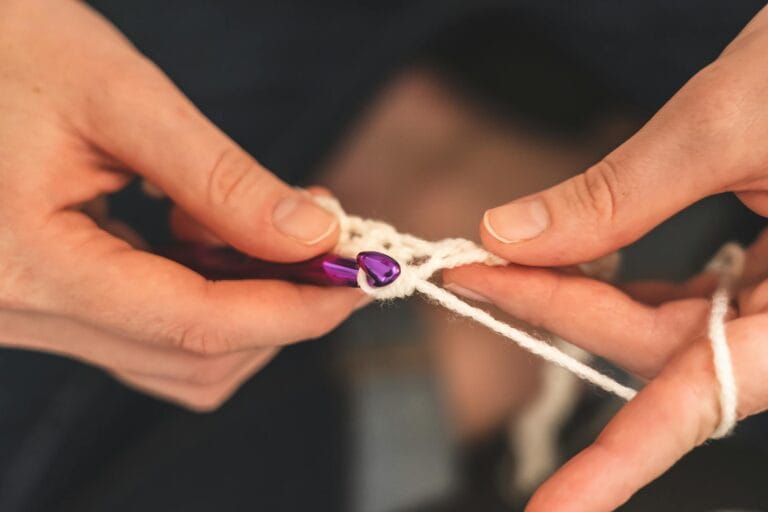
The yarn wrap test. Hold your hook in your dominant hand and wrap the yarn around it once. Now pull the yarn gently. It should move smoothly but with a slight resistance. If it slides through with zero resistance, your tension is too loose. If you have to tug hard, your tension is too tight. Adjust your grip until you find that sweet spot.
Conscious breathing while crocheting. Many crocheters do not realize that they hold their breath or breathe shallowly when concentrating on a tricky stitch. This unconsciously tightens your hands and increases tension. Practice taking slow, deep breaths while you crochet. You will find that your stitches become more even almost immediately.
When to Block vs. When to Fix the Root Cause
Blocking is a fantastic technique for fixing mild curling, but it is important to understand when blocking is the right solution and when you need to address the underlying issue instead. Using blocking as a crutch for a persistent problem will only lead to frustration when the curling returns after washing.
Blocking is the right choice when: Your curling is mild and only noticeable at the edges. This is completely normal for many stitch patterns, especially those with a lot of single crochet or half double crochet. A quick spray blocking session will flatten the edges and your project will look perfect.
Fix the root cause when: Your curling is severe enough to distort the shape of your project. If your scarf is rolling into a tube, your blanket edges are curling up by several inches, or your amigurumi pieces are not lying flat, blocking alone will not solve the problem. You need to identify whether the issue is your tension, your hook size, or your stitch pattern and make the appropriate adjustment.
Combination approach. For the best results, fix any root cause issues and then block the finished piece. This two-step approach ensures that the problem is resolved at its source and the finished project looks as polished as possible. Mastering the art of fixing curling crochet is one of the most rewarding steps you can take as a crocheter.
Helpful next crochet tutorials
- How to Crochet for Beginners
- How to Read a Crochet Pattern
- Crochet Hook Sizes
- Best Yarn for Beginner Crochet
- Easiest Crochet Projects for Beginners
Why Is My Crochet Curling: Common Causes
One of the most frustrating experiences for any crocheter is finishing a beautiful piece only to notice the edges rolling or the fabric cupping. If you are wondering why your crochet is curling, the answer usually comes down to a few key factors. This curling issue is typically caused by tight tension, incorrect hook size, or working too many stitches in a single row without enough increases. Even experienced crafters deal with this issue occasionally, so do not feel discouraged.
The root cause often relates to how tightly you hold the yarn and hook. When your stitches are too tight relative to the yarn thickness, the fabric naturally wants to curl inward. Another frequent culprit is using a hook that is too small for the yarn weight, this creates dense, stiff stitches that pull the edges toward the center of the work. Many new crocheters face the frustration of why is my crochet curling in their first projects.
Step-by-Step Fixes for When Your Work Starts to Curl
Start by checking your tension: make a small swatch and compare your stitch count to the pattern recommendation. If your stitches per inch are higher than the pattern states, switch to a larger hook. Next, count your stitches at the end of every single row, adding even one extra stitch or missing one stitch can cause gradual curling that becomes more noticeable over time. Finally, try wet blocking your finished piece: pin it flat, spray with water, and let it dry completely. Blocking alone fixes mild to moderate curling in most cases.
How Do You Fix Common Crochet Problems?
- Check the material choice
- Check stitch count or round count
- Compare your work to the intended shape
- Repeat the same motion more slowly
- Use one related guide to confirm the next step

Understanding why is my crochet curling means knowing how tension, hook size, and stitch choice interact.
What Is this crochet curling issue final takeaway?
When you are dealing with curling crochet edges, the cleanest progress usually comes from making one correction at a time, testing it quickly, and only then moving on to the next variable.
Bottom line
If you want better results when fixing crochet curling, keep the setup simple, practice the same method long enough to judge it properly, and use one closely related guide as your next step instead of jumping around randomly. If you are tired of why is my crochet curling, blocking your work can help flatten it out.
Trusted external reference
For an authoritative reference related to crochet curling, see the Craft Yarn Council resource.
This matters because curling crochet edges often feels harder when too many variables change at once. A calmer setup, clearer materials, and a simpler next step usually produce better results.
More help with this crochet curling issue
Why is my crochet curling when I work in the round?
Curling in the round usually means your increase rate does not match the stitch height. If the crown of a hat or the start of an amigurumi piece is bowl-shaped, you need more increase stitches. If it is rippling or waving, you have too many increases and should remove a round or two. The key is to keep checking that your circle lies perfectly flat before moving on to even rounds.
Why is my crochet curling even after blocking?
If blocking did not solve the problem, the issue is likely structural rather than tension-related. Check whether your turning chains are the correct height for your stitch, for example, double crochet requires a chain-3 turning chain, while half double crochet needs only a chain-2. A turning chain that is too short will pull the edge downward and cause persistent curling that no amount of blocking can fix.
Why is my crochet curling only on one side?
One-sided curling almost always points to inconsistent tension between your right-side and wrong-side rows. Many crocheters naturally tighten up or loosen their grip when they turn the work. To fix this, pay extra attention to how your yarn hand feels on both sides and try to match the tension. Placing a stitch marker on the first and last stitch of every row also helps you spot the problem early.
If the curling problem still feels frustrating, compare your current result to the intended shape, check whether your yarn and hook are helping or hiding the stitch, and move to one closely related guide before changing everything at once.
Frequently Asked Questions
Why is my crochet curling at the edges?
Your crochet may be curling at the edges because you are working with a stitch pattern that naturally pulls inward, such as single crochet or tightly worked half double crochet. Curling can also occur if your foundation chain is too tight relative to the rest of your stitches, creating uneven tension across the fabric. Understanding why your crochet is curling is the first step to preventing and correcting it in future projects.
Will blocking fix curling in crochet?
Yes, blocking is one of the most effective ways to fix curling in crochet by relaxing the yarn fibers and allowing you to pin the fabric flat to dry in the correct shape. Steam blocking works particularly well for acrylic yarns, while wet blocking is recommended for natural fibers like cotton, wool, and bamboo. While blocking can resolve most curling issues, it may need to be repeated after washing if your crochet piece continues to curl.
How do I prevent my crochet from curling while working?
To prevent your crochet from curling while working, try using a larger hook size to loosen your overall tension, especially for the first few rows which are most prone to pulling inward. You can also try adding a border of a different stitch pattern, like a row of double crochet or shell stitches, which naturally counters the inward pull of tighter stitches. Being mindful of your tension from the very beginning is the best way to stop wondering why your crochet is curling.
Does yarn type affect crochet curling?
Yes, yarn type significantly affects crochet curling because different fibers have different natural tendencies, cotton and linen tend to be stiffer and more prone to curling, while wool and alpaca have more natural drape and bounce. Synthetic acrylic yarns can develop curling from the manufacturing process and may need more aggressive blocking. Choosing a yarn with good drape is an easy way to reduce the chance of your crochet curling throughout your project.