How to Read Crochet Symbols: 12 Essentials Explained
Learning to read crochet symbols is like getting glasses you didn’t know you needed: that wall of “dc in next 3 sts, ch 1, skip 1” turns into a picture you can see at a glance. A symbol chart shows every stitch of a pattern as a little glyph placed exactly where the stitch goes, and once you know a dozen symbols, you can follow charts from designers all over the world, in any language.
As an Amazon Associate we earn from qualifying purchases: some supply links in this post are affiliate links, at no extra cost to you.
Why Crochet Symbols Exist
Written instructions describe stitches one at a time, which works until a round has forty of them and your eyes glaze. Charts solve three problems at once: they show where each stitch lands, not just what it is; they compress a paragraph into a picture; and they cross language barriers, which is why Japanese amigurumi books and German blanket patterns are crochetable without translation. Most modern patterns give you both, and skilled crocheters bounce between the two.
The One Rule That Unlocks Everything
Here is the secret that makes crochet symbols easy to memorize: the taller the stitch, the taller the symbol. A chain is a flat little oval. A single crochet is a short cross. Then the T family begins: a plain T for half double, and one extra tick across the stem for each yarn over after that: one tick for double crochet, two for treble, three for double treble. You never really memorize twelve symbols; you memorize one rule and a few special shapes.
The 12 Crochet Symbols You’ll Meet First
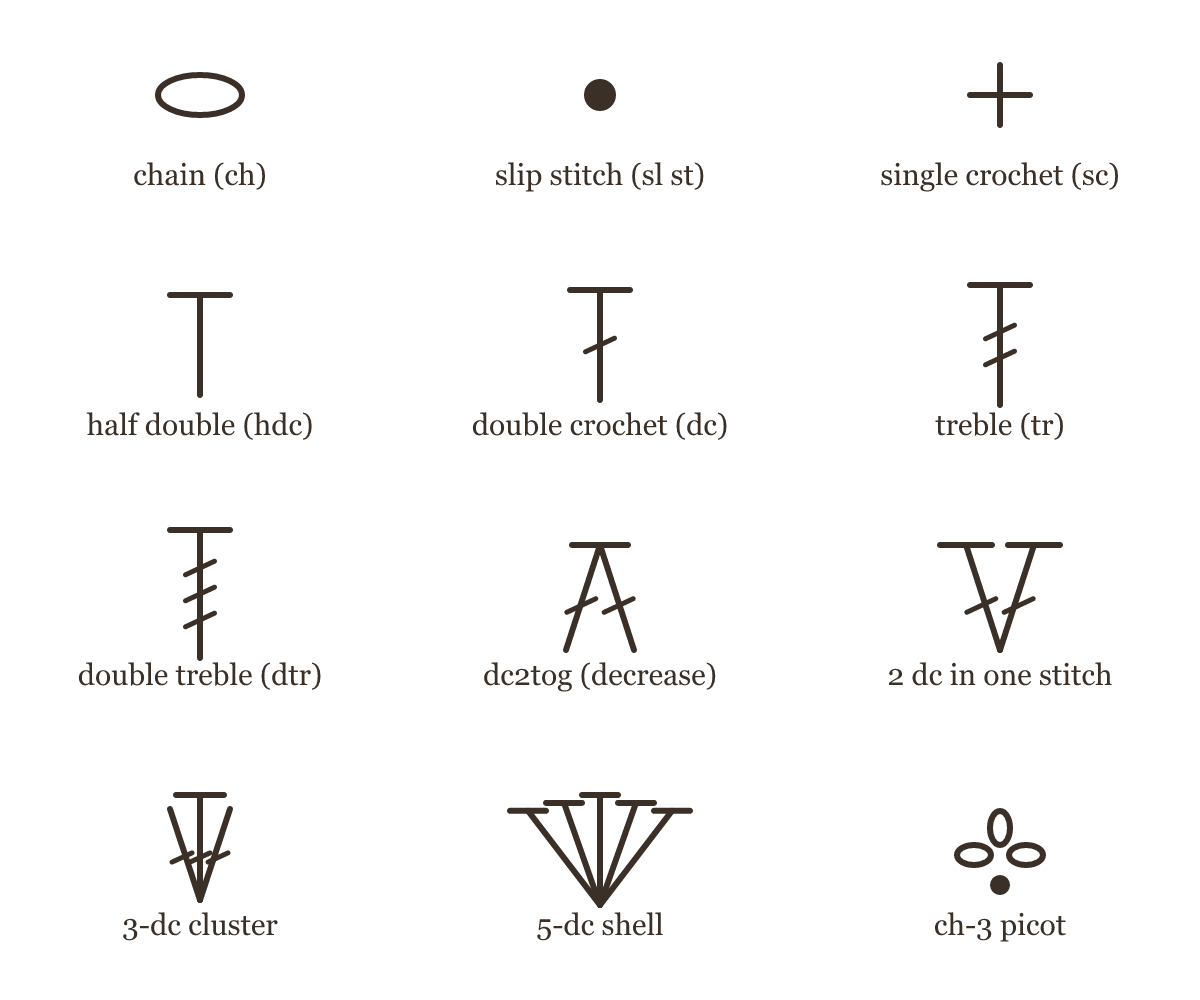
These twelve cover the vast majority of charts you’ll encounter. A few reading notes: combined stitches follow a logic too. When stems join at the top, stitches are worked together into one (a decrease, like dc2tog). When stems share one base, they’re all worked into the same stitch (an increase or a shell). The cluster joins at both ends: several stitches into one base, closed with a single pull-through. Our chart follows the Craft Yarn Council standard symbols; individual designers may draw small variations, which is why every good chart ships with a key.
How to Read a Chart Worked in Rows
Row charts read like a boustrophedon, which is a fancy word for how oxen plow a field: back and forth. If you crochet right handed, you read Row 1 right to left, Row 2 left to right, and so on, exactly mirroring how the fabric grows in your hands. Left handed crocheters mirror everything.
You never have to remember which way you’re going: the row number is printed at the end where the row starts. Number on the right, read leftward. Number on the left, read rightward. The turning chains at the row edges are drawn as their little ovals, so even those stop being mysterious.
How to Read a Chart Worked in Rounds
Round charts start in the center and spiral outward, and you read them counterclockwise if you crochet right handed (clockwise for lefties), because that’s the direction your stitches actually march around the work. Here’s a simple flat circle chart in single crochet, the foundation of nearly every amigurumi:
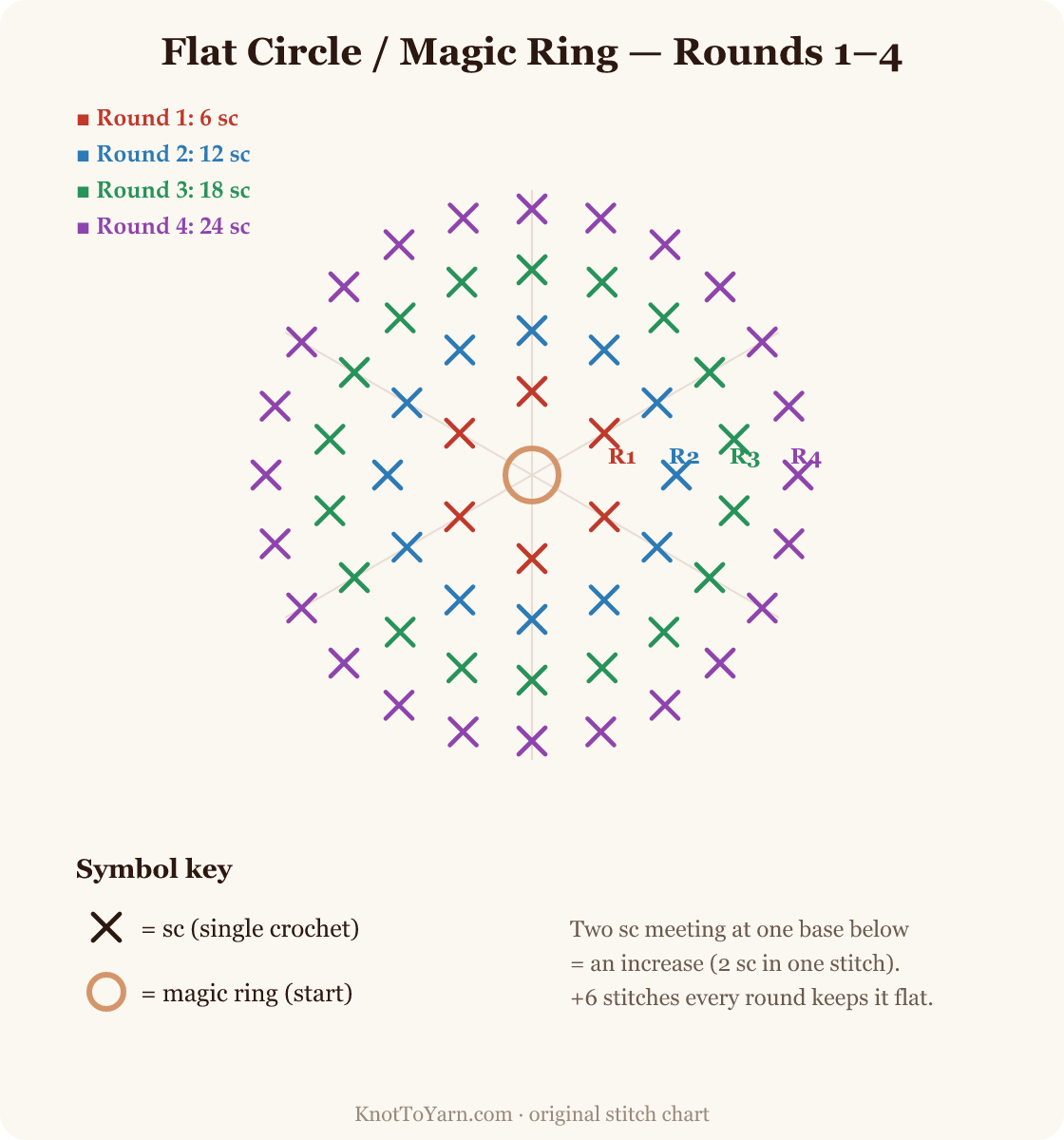
Trace it from the middle: the ring, then a round of crosses, then rounds where the increases (two crosses sharing a base) appear at regular intervals. Now something a little richer, the classic granny square’s first three rounds:
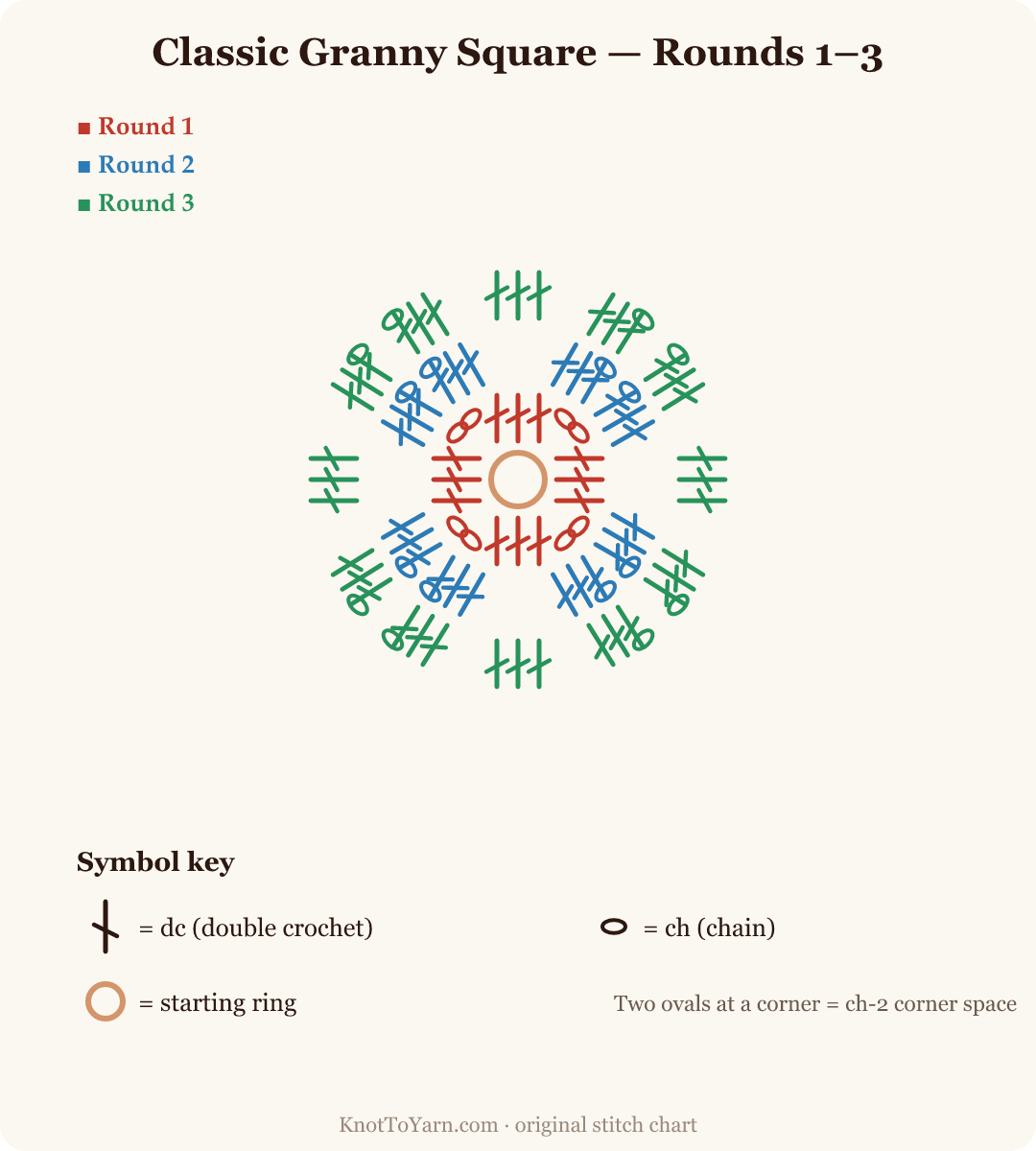
Notice how much the chart tells you instantly: the 3-dc clusters read as little fans of ticked stems, the chain spaces are the ovals between them, and the corners are unmistakable because you can see the bigger gaps. That spatial information is exactly what written instructions struggle to convey.
Special Marks Worth Knowing
Two more things you’ll bump into. First, a tiny half-oval arc attached to the base of a stitch means work into one loop only (front or back loop instead of both); which loop depends on the arc’s orientation, and conventions vary just enough between publishers that the pattern key is the reliable answer. Second, colored charts: multi-color designs often print each round in its yarn color, which turns the chart into a color map too. When in doubt, the key wins over memory, always.
Practice Supplies
All you need to practice is scrap yarn, a comfortable crochet hook, and a few stitch markers to mark the first stitch of each round while you learn to see the chart in your fabric. Pick any chart from this post, work it in a smooth light-colored worsted yarn, and compare your fabric to the picture as you go: the moment the two match, symbols have clicked.
Practice on These Charts
Reading about symbols only takes you so far. These patterns on this site each include an original chart next to the written instructions, so you can work a round from the words, then find that same round in the picture. That back and forth is where chart reading actually clicks.
- Granny Square Baby Afghan: 7 Ideas + a Free One-Square Pattern
- Granny Square Cushion: 7 Ideas + a Free Button-Back Pattern
- Crochet Summer Top: 7 Stunning Ideas + a Free One-Square Halter
- Amigurumi Toy Patterns: 7 Ideas for Beginners + a Free Starter Pattern
Tips for Learning Crochet Symbols Faster
- Read charts you’ve already crocheted. Take a pattern you know by heart and study its chart; connecting known stitches to their symbols is the fastest way in.
- Trace with a pencil. On a printed chart, mark off each round as you finish it, exactly like crossing off written rows.
- Count the ticks, not the shape. When symbols get tall, the tick count is the stitch: one tick, double crochet; two, treble.
- Keep the key beside you. Even chart veterans check the key on a new pattern; designers’ clusters and puffs vary the most.
Ready to put symbols to work? Our bee granny square was tested stitch by stitch by a real crocheter and is a good first chart-and-words project, the double crochet tutorial covers the stitch behind the most common symbol, the color changing guide pairs naturally with colored charts, and the granny square hub is full of motifs to practice chart reading on.
Crochet Symbols FAQ
Are crochet symbols international?
Mostly yes: charts follow international conventions, which is why Japanese and European patterns are readable without translation. Small publisher differences are covered by each pattern’s key.
Is single crochet an x or a plus?
Both appear; they mean the same stitch. Japanese charts prefer the x, many US charts use the plus.
Which direction do I read?
Rows alternate direction (the row number sits where the row starts); rounds read counterclockwise from the center for right handed crocheters.
Charts or written patterns first?
Written first, charts as the map. Use the chart when the words stop making sense.
If reading crochet symbols finally clicked for you here, send us a photo of your first chart-made project through the contact page. Happy crocheting!