how to crochet for beginners hands

Crochet Magic Ring: 7 Beginner Steps, Fixes, and Common Mistakes


Table of Contents

What you will learn

  • the quick answer
  • why beginners struggle
  • step-by-step fixes or methods
  • common mistakes
  • helpful next steps
crochet magic ring

crochet magic ring

This example adds context before the next image so the tutorial stays easy to follow.

crochet magic ring

Crochet Magic Ring at a glance

  • Topic: crochet magic ring
  • Skill level: beginner
  • Main goal: help the reader complete the technique, fix common mistakes, and know the next useful crochet step
  • Related topics: crochet hooks, yarn choice, pattern reading, tension, stitch control

Quick answer

Crochet Magic Ring gets easier when you focus on the exact fix, step, or comparison that matters most first. This guide is built to give you the fast answer, then the beginner-friendly explanation, practical checks, and the next tutorial to open after this one.

Crochet Magic Ring gets easier when you use the right materials, follow a clear sequence, and avoid the mistakes that slow beginners down. This guide gives you the quick answer first, then the practical steps, examples, and next tutorials that help you improve faster.

Crochet magic ring (MR) is a beginner crochet stitch used for amigurumi, hats, coasters, granny-style circles, and any project that starts in the round. It creates an adjustable center for working in the round—wrap yarn to form a loop, crochet the first round into the loop, then pull the tail to tighten the center. The most common beginner mistake is pulling the tail before the first round is secure—hold the ring firmly, crochet the required stitches first, then tighten slowly.

Tip: if your edges look messy, mark the last stitch of each row with a stitch marker until your stitch count stays consistent.

At a glance

  • Skill level: Beginner
  • Abbreviations: ch, MR, YO
  • Turning chain: No turning chain concept; you work Round 1 into the ring, then join/continue as the pattern instructs.
  • Best practice yarn: medium weight (#4), light color

Common mistakes → quick fixes

  • Tight stitches: loosen grip; size up 0.5 mm if needed.
  • Crooked edges: count stitches; mark the last stitch.
  • Wrong height: repeat the rhythm slowly and pull through the right number of loops.

Mini glossary

ch (chain), MR (Crochet magic ring), YO (yarn over), turning chain, stitch marker, tension, loops, stitch count.


The crochet magic ring (also called a magic circle or adjustable ring) is one of those techniques that looks intimidating until it clicks—and then you’ll use it constantly. It’s the cleanest way to start crocheting in the round because you can tighten the center almost completely closed.

crochet magic ring

If you’ve ever started a hat, coaster, granny square, or amigurumi toy and ended up with a hole in the middle, this tutorial is for you. I’ll show you a beginner-friendly method for making the ring, how to crochet your first stitches into it, how to tighten it properly, and how to secure the tail so it doesn’t loosen over time.

If you’re brand new to crochet and want a guided path, start at Start Here and visit the Beginner Crochet hub.

What is a crochet magic ring?

crochet magic ring

A crochet magic ring is a starting method used for patterns that begin in the round. Instead of chaining and joining into a fixed circle, you form a loop of yarn and crochet your first round of stitches into that loop. When the first round is complete, you pull the yarn tail to tighten the loop—closing the center hole.

In other words: it’s an adjustable start. That adjustability is what makes it so useful.

When should you use a crochet magic ring?

You can use a magic ring any time a pattern starts with “work X stitches into a ring.” It’s especially helpful when you want a tight center.

  • Amigurumi: a tight center prevents stuffing from showing.
  • Top-down hats: the crown looks neat with no hole.
  • Granny squares: a snug center gives a more polished look.
  • Coasters and motifs: a clean, closed start looks finished.

If you want to practice this in a fun, motivating way, pair it with a simple motif like How to Make a Granny Square, then explore more projects in Granny Squares and Free Patterns.

What you need

  • Yarn (any weight)
  • Crochet hook that suits your yarn
  • Scissors
  • Optional: stitch marker (very helpful for counting in rounds)

Stitches and abbreviations you’ll see

Magic ring tutorials usually mention a few common abbreviations. Here are the most typical:

  • ch = chain
  • sc = single crochet
  • dc = double crochet
  • sl st = slip stitch

For a standard list of crochet abbreviations, see Craft Yarn Council crochet abbreviations.

Crochet magic ring: step-by-step (beginner-friendly method)

There are a few ways to form the ring. The method below is simple, stable, and easy to repeat. Read through once, then try it with a smooth, light-colored yarn so you can clearly see the strands.

Step 1: Leave a tail

Pull out a yarn tail about 6–8 inches (15–20 cm) long. This tail is what you’ll pull to close the ring, and you also need enough length to weave it in securely later.

Step 2: Form a loop

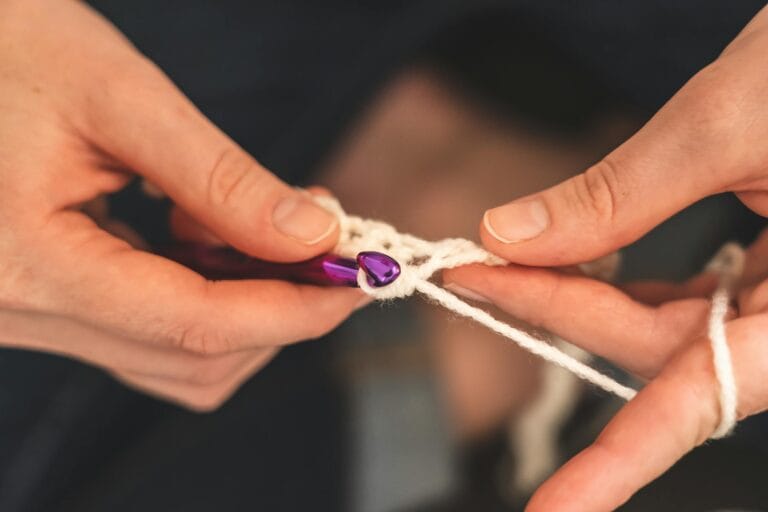
Hold the tail in your non-dominant hand. Lay the working yarn (the strand connected to the yarn ball) over it to form a loop. You want the working yarn crossing over the tail so you have a clear “X” shape.

The exact direction you wrap doesn’t matter as much as being consistent—what matters is that you can identify which strand is the tail and which is the working yarn.

Step 3: Insert the hook and pull up a loop

Insert your hook under the front strand of the loop. Yarn over with the working yarn and pull up a loop onto your hook.

Beginner tip: Keep the loop big enough that your hook fits easily. If the loop is tiny, the first stitches will feel cramped and frustrating.

Step 4: Chain to secure the ring

Chain 1 to secure the ring.

Important: whether this chain counts as a stitch depends on your pattern. Many patterns treat it as “just a securing chain.” Others count it as the first stitch. Always follow the pattern instructions.

Step 5: Crochet stitches into the ring

Now crochet the required number of stitches into the center of the ring (around the loop). You’ll insert your hook into the center opening, yarn over, and complete the stitch as usual.

Common examples:

  • Amigurumi: often 6 sc into the ring
  • Flat circle in dc: often 10–12 dc into the ring (pattern-specific)
  • Granny square start: often a sequence of dc clusters into the ring

Counting tip: Place a stitch marker in stitch #1 right away. Beginners often lose track of where the round starts, and a marker makes it much easier to count and join correctly.

Step 6: Tighten the magic ring

Once you’ve made the required stitches, hold the stitches with one hand and gently pull the tail with the other. The loop will tighten and the center hole will close.

If it doesn’t tighten, don’t force it. See the troubleshooting section below—usually it means the tail strand got caught in a way that prevents sliding.

Step 7: Join or continue (depending on your pattern)

Patterns handle the next step in one of two ways:

  • Joined rounds: you join to the first stitch (often with sl st) and start the next round.
  • Continuous rounds: you do not join; you keep crocheting in a spiral and use a marker to track rounds.

This matters because using the wrong method can change the look of the round and affect stitch counts. If the pattern says “join,” join. If it says “work in continuous rounds,” keep going with your marker.

How to secure the tail so the ring doesn’t loosen later

A magic ring looks neat, but it needs proper securing—especially on items that get handled a lot (amigurumi) or stretched (hats). The center can loosen if the tail isn’t woven in well.

A secure method:

  • After you crochet 2–3 rounds, thread the tail onto a yarn needle.
  • Weave the tail through the backs of several stitches on the wrong side.
  • Change direction and weave back through different stitches.
  • Repeat once more if your yarn is slippery.

Changing direction is the key. It “locks” the yarn in place.

Tension tips for a neat crochet magic ring

The magic ring feels awkward because you’re controlling multiple strands. The most common beginner mistake is tightening the ring too early. If you tighten before you’ve finished the first round, the stitches become cramped and difficult to work into.

Instead:

  • Keep the ring loop open and roomy while you crochet the first stitches.
  • Focus on consistent loop height so the first round looks even.
  • Only tighten the ring after the first round stitches are complete.

After you tighten, gently slide the stitches around the ring with your fingers so they distribute evenly. This helps the round sit flat and look smooth.

Common crochet magic ring mistakes (and easy fixes)

My ring won’t close

Usually cause: you’re pulling the working yarn instead of the tail, or the tail strand got trapped by your stitches.

Fix: identify the tail (the short end) and pull that. If it still won’t slide, gently loosen the first stitch or two with your hook tip, then pull the tail again. If it’s fully locked, restart and keep the tail strand free—crochet around the ring loop, not through the tail itself.

I tightened it, but I still see a tiny hole

Cause: some yarns are springy or the first stitches aren’t snug.

Fix: thread the tail through the first-round stitches like a drawstring, pull again to cinch, then weave in securely. Many crocheters do this extra cinch step for amigurumi to get the tightest center.

My first round looks messy

This is normal. Round one is often the messiest part of any project. The best fixes are:

  • Use a smooth, light yarn for practice.
  • Use a stitch marker in stitch #1.
  • Slow down and count carefully.

After round two, everything typically looks much cleaner.

The ring loosened after a few days/weeks

Cause: the tail wasn’t woven in securely, or it was cut too short.

Fix: always leave a long tail and weave in back and forth, changing direction. If the ring has already loosened, you may be able to re-tighten the tail from the wrong side and then re-weave it, depending on the project.

Magic ring alternatives (if you hate it right now)

If the magic ring feels too fiddly, that’s okay. You can still make beautiful projects using a chain start. The trade-off is that the center won’t tighten fully closed (you’ll have a small hole). For many motifs, that hole is totally fine.

Alternative 1: Chain 2 method

Chain 2, then crochet the required stitches into the second chain from the hook. This can be easier than crocheting into a ring for some beginners.

Alternative 2: Chain 4 + slip stitch ring

Chain 4, slip stitch into the first chain to form a ring, then crochet the first round into that ring.

These alternatives are also useful if you’re working with very slippery yarn that doesn’t hold a magic ring well.

Practice ideas (so the magic ring clicks faster)

Practice goes faster when the practice has a purpose. Instead of making random circles, try one of these:

  • Make 3–5 tiny circles that start with 6 sc, then increase once. (Great for amigurumi basics.)
  • Start a granny square using a magic ring, then complete 2 rounds. (Motivating because it looks “real.”)
  • Start a simple beanie top and do the first 3 rounds. (Great round-counting practice.)

If you want a beginner-friendly project list that builds skills in order, see Crochet Patterns for Beginners.

Magic ring anatomy: what you’re actually crocheting around

Understanding what’s happening under your fingers makes the magic ring much less mysterious. When you form the loop, you essentially have two strands in front of you:

  • The ring loop strand (the strand that will slide closed)
  • The tail strand (the free end you’ll pull and later weave in)

In most beginner-friendly magic ring methods, your first-round stitches are worked around the ring loop strand. That’s what allows the loop to slide smaller when you pull the tail. If your stitches accidentally trap the tail strand in a tight way, the loop can’t slide—and the ring won’t close.

Worked example: 6 single crochet into a magic ring (amigurumi start)

Many amigurumi patterns start with 6 sc in a magic ring because it creates a small, tight base that increases smoothly into a ball shape.

Here’s what that looks like in plain language:

  • Make the ring and ch 1 to secure (do not count this as a stitch unless the pattern says so).
  • Work 6 sc into the center of the ring.
  • Pull the tail to close the center.

After that, patterns usually continue with increases such as “Round 2: inc in each stitch (12).” That means you work 2 sc in each stitch from the previous round, doubling your stitch count from 6 to 12.

Counting tip: Because continuous rounds are common in amigurumi, place a marker in the first stitch of the round and move it up each round. This prevents losing your place and accidentally adding an extra increase.

Joined rounds vs continuous rounds (why your circle sometimes looks “stepped”)

Beginners often notice a little “step” or jog when crocheting in the round. This can happen for two reasons:

  • Joined rounds create a seam where you join and start again.
  • Continuous rounds spiral upward, which can shift color changes and stitch placement slightly.

Neither is wrong. They’re just different systems. If you’re making a granny square, you’ll usually use joined rounds. If you’re making amigurumi, you’ll often use continuous rounds. Following the pattern’s system is what creates the intended look.

How to get an extra-tight center (pro trick for slippery yarns)

Some yarns are smooth or springy and want to “re-open” a tiny hole even after you tighten. If you need the center fully closed (common for amigurumi), try this:

  • After tightening, thread the tail onto a yarn needle.
  • Pass the needle through the loops of the first-round stitches, circling the center like a drawstring.
  • Pull the tail again to cinch.
  • Then weave the tail back and forth to lock it in place.

This extra drawstring pass often closes the last tiny gap and keeps it closed long-term.

Left-handed note (and why direction doesn’t really matter)

If you crochet left-handed, the loop formation might look mirrored compared to some tutorials. That’s okay. The main idea is the same: you need a loop that can slide, a tail you can pull, and stitches worked around the loop. If a tutorial’s direction feels backwards, mirror it—what matters is that you can identify the tail and successfully tighten the center.

Best yarn and hook for practicing the magic ring

If you’re learning, your materials matter. Pick a smooth, light-colored yarn (so you can see the strands) and a hook that isn’t too small for the yarn. If the hook is tiny, the first stitches will feel tight and you’ll struggle to insert the hook into the ring. A medium yarn (worsted) with a 5.0 mm hook is a comfortable practice combo for many beginners.

Once the motion feels natural, you can use the technique with any yarn weight.

Quick recap (60 seconds)

If you want the magic ring steps in the simplest form, here’s the whole flow: make a loop with a tail, pull up a loop with your hook, chain to secure, work your first stitches around both strands, then pull the tail to close the center. After that, secure the tail by weaving it in with direction changes so it can’t loosen during washing or wear.

When your ring won’t tighten, it’s almost always because you crocheted only around one strand instead of around the full ring (both the loop and the tail). If that happens, loosen the stitches gently, re-form the ring, and try again with a larger loop so you can clearly see the strands.

FAQ: Crochet magic ring

Is a magic ring the same as a magic circle?

Yes. “Magic ring,” “magic circle,” and “adjustable ring” all refer to the same technique.

How many stitches go into a magic ring?

It depends on the pattern. Many amigurumi patterns start with 6 sc. Flat circles often start with more stitches (especially in double crochet). Always follow the pattern’s stitch count.

Do I count the chain-1 as a stitch?

Usually no, but it depends on the pattern. Some patterns count a starting chain as the first stitch for certain stitch types. If the pattern includes stitch counts, that usually clarifies whether the chain counts.

Can I use a magic ring for granny squares?

Yes, and it’s a great way to get a tight center. If you prefer a small decorative hole in the middle, use a chain ring instead.

How long should my yarn tail be?

Aim for 6–8 inches (15–20 cm). Short tails are the #1 reason magic rings loosen over time because there isn’t enough yarn to weave in securely.

Related guides on KnotToYarn

More tutorials and patterns to keep going:

Next steps

FAQ

What is the easiest way to start a crochet magic ring?

Beginners usually do better when they choose one method and repeat it slowly instead of switching tutorials every few minutes.

Why does my magic ring come loose?

A loose tail, weak first stitches, or not tightening the center fully can all cause the ring to open over time.

Continue with these related guides

What matters most for ranking and results

The strongest beginner crochet pages answer the search intent directly, solve the most common problems, and point the reader toward the next useful tutorial instead of leaving them stuck.

Related search questions

What should beginners focus on first?

Beginners usually improve fastest when they start with a simple, repeatable project or technique and build confidence before adding complexity.

Why do beginners struggle with this?

Most beginner problems come from trying to learn too many new variables at once. A simpler process usually leads to better-looking crochet much faster.

Continue with these closely related guides


Crochet Magic Ring FAQ

How long does it take to get comfortable with crochet magic ring?

Most beginners improve quickly when they practice in short repeatable sessions and keep the materials simple enough to see the stitch shape clearly.

What mistakes slow progress the most?

The biggest slowdowns usually come from rushing, inconsistent stitch counts, unclear patterns, and switching tools or yarn before the basic motion feels steady.

What should I learn after crochet magic ring?

The next step depends on your goal, but most beginners improve faster when they move into one related tutorial immediately and reinforce the skill while it is still fresh.

Related beginner crochet guides

Crochet Magic Ring quick questions

What should I check first?

Start with the most visible cause: your materials, stitch count, tension consistency, or whether you are following the same motion all the way through the row or round.

Why does this keep happening?

Beginners usually repeat the same mistake because the early warning signs are small. The fix is to slow down, simplify the setup, and check the work before the problem grows.

What related skill should I learn next?

Choose the next guide that supports this exact problem, so your practice connects naturally instead of feeling random.

Helpful next crochet tutorials

Bottom line

If you want better results with crochet magic ring, keep the setup simple, check the most likely cause first, and use one closely related crochet guide as the next step so your practice keeps building in the right direction.

Similar Posts

3 Comments

Leave a Reply

Your email address will not be published. Required fields are marked *