5 Simple Ways How to Count Crochet Rows: Essential Tips

How to Count Crochet Rows at a Glance
- Topic: how to count crochet rows
- Skill level: beginner
- Main goal: help the reader accurately track and count rows in any crochet project without losing their place
- Related topics: crochet stitch counting, reading crochet patterns, crochet row markers, beginner crochet tips, crochet tension
Quick Answer
Learning how to count crochet rows is one of the most important skills you can develop as a new crocheter. The simplest method is to count the vertical bars (or “V” shapes) running along the edge of your fabric — each set of V-stitches represents one row. Using a row counter, stitch markers, or a running tally on paper makes it even easier to stay on track.
Tip: Count your rows from the wrong side of the fabric — the stitches are often more visible and easier to distinguish on the back of your work.
 KnotToYarn
Subscribe to KnotToYarn!
Get the best free crochet patterns, tutorials & tips delivered straight to your inbox. Join our growing community!
At a Glance
- Skill level: beginner
- Time needed: 5 minutes to learn, a lifetime to master
- Best yarn: smooth, light-colored worsted weight (dark or fuzzy yarn hides stitches)
- Hook size: any size you are comfortable with
Common Mistakes → Quick Fixes
- Counting chains as rows: your foundation chain is Row 0 — the first actual row is worked into that chain.
- Miscounting the turning chain: the turning chain at the start of a row is part of the row count, not a separate row.
- Forgetting to count the current row: place your marker after completing the row, not before starting it.
Mini Glossary
ch – chain, sc – single crochet, hdc – half double crochet, dc – double crochet, t-ch – turning chain, RS – right side, WS – wrong side, st(s) – stitch(es), blo – back loop only, flo – front loop only
Why Learning How to Count Crochet Rows Changes Everything
If you have ever finished a crochet project only to realize one side is noticeably longer than the other, you already know why how to count crochet rows matters. Uneven edges, mismatched pattern repeats, and garments that do not fit all stem from the same root problem: lost row count.
Counting rows is not just about neatness. When you follow a written pattern, the instructions are built around row numbers. If you lose track of where you are, the stitch sequence falls apart. A scarf that should have a symmetrical ripple becomes lopsided. A blanket that should measure 40 inches ends up at 35 or 45. Knowing how to count crochet rows is the single most practical skill that separates confident crocheters from frustrated beginners.
The good news is that row counting is simple once you learn a few reliable methods. Below are five approaches you can start using today, no special tools required.
Method 1: Count the Vertical Bars Along the Edge
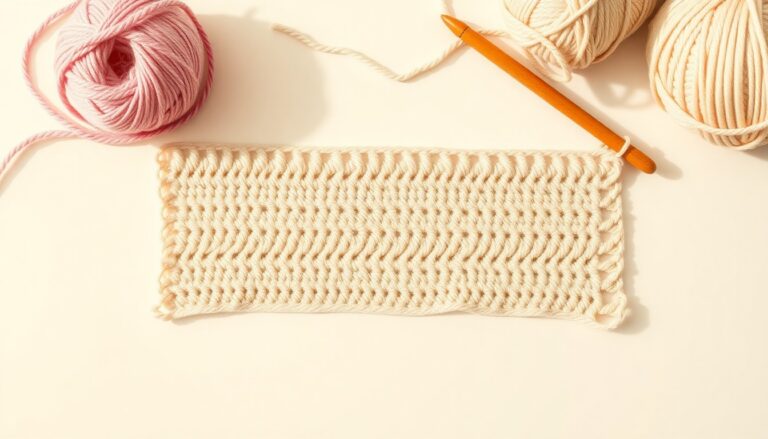
This is the most visual method and the one every crocheter should learn first. When you work in rows with basic stitches — single crochet, half double crochet, or double crochet — each completed row leaves a chain of vertical bars along the side edge of your fabric. These bars look like a series of stacked V-shapes.
To count your rows, turn your work so the side edge faces you. Starting at the bottom, count each V going upward. Each V equals one row. For single crochet, the Vs are short and compact. For double crochet, they are taller and more spread out. The principle is the same regardless of stitch height.
This method works best on flat pieces worked in turned rows using a smooth, light-colored yarn. If you are learning the fundamentals, our beginner crochet guide covers the basic stitches you will be counting.
Method 2: Use a Digital or Mechanical Row Counter
A row counter is a small tool — either digital or mechanical — that you click after completing each row. Digital counters are inexpensive and widely available, while mechanical versions use a numbered dial that you rotate with your thumb.
The key to using a row counter effectively is consistency. Click the counter the moment you finish the last stitch of a row and before you chain for the turning chain of the next row. If you wait until you are two or three stitches into the new row, you will eventually forget to click and lose your count.
This is the preferred method for projects with long row repeats, like crochet scarf patterns, where you might work 200 identical rows in a single piece. Without a counter, losing track is almost guaranteed.
Method 3: Place a Stitch Marker at the Start of Every Row
Stitch markers are not just for amigurumi in the round. When you work in flat rows, place a removable marker in the first stitch of every row (or in the turning chain). When you look at your work, you can count the markers to know exactly how many rows you have completed.
This method is especially useful when you need to know how to count crochet rows in textured stitch patterns like basket weave or cables, where the edge V-shapes from Method 1 can be difficult to read. The markers provide a reliable counting system that does not depend on stitch appearance.
Use locking stitch markers so they do not fall out when you set your project down. If you are following a complex pattern, our guide on how to read a crochet pattern explains how row markers pair with written instructions.
Method 4: Keep a Tally on Paper or a Phone App
Sometimes the old-school approach is the best. Keep a notepad next to your crochet chair and make a tally mark for every row you complete. Group them in sets of five so they are easy to read at a glance — four vertical lines with a diagonal slash through them.
If you prefer digital, there are several free phone apps designed specifically for crochet and knitting project tracking. These apps let you name your project, set a target row count, and log your progress with a single tap. Some even send you reminders if you have not logged a row in a while.
The paper method has one big advantage: it never runs out of battery. Many experienced crocheters keep a small notebook in their project bag as a permanent record of every piece they make, including the yarn used, hook size, and final row count. This becomes an invaluable reference for future projects.
Method 5: Count Ridges in Half Double Crochet and Double Crochet
If you are working in half double crochet or double crochet, your fabric will develop horizontal ridges on the front (or “right”) side. These ridges correspond to each completed row. Counting them is one of the fastest ways to determine how to count crochet rows in taller stitch patterns.
Here is how it works: turn your work so the right side faces you. Look for the horizontal lines running across the surface of the fabric. Each line represents one row of HDC or DC. Simply count the lines from bottom to top.
This method does not work well with single crochet because SC does not create prominent ridges. It also becomes unreliable in heavily textured patterns where the ridges are obscured by post stitches or color changes. But for straightforward HDC or DC fabrics, it is remarkably fast and accurate.
Understanding different stitch types helps you choose the best counting method. Our crochet abbreviations guide is a handy reference when you encounter unfamiliar stitch names in patterns.
How to Count Crochet Rows in Special Situations
Working in the Round
When you crochet in the round — as you do with amigurumi, hats, and beanie crochet patterns — there are no row edges to count. Instead, use the continuous spiral technique: place a stitch marker in the first stitch of each round and move it up as you complete rounds. Count the marker positions or keep a running tally.
KnotToYarn
Subscribe to KnotToYarn!
Get the best free crochet patterns, tutorials & tips delivered straight to your inbox. Join our growing community!
When Using Multiple Colors
Color changes actually make row counting easier in some ways because each color stripe represents a set number of rows. If your pattern alternates 4 rows of white and 4 rows of blue, you can count by color blocks and multiply. Just be careful at the transition point — the first and last rows of each color block are the easiest to miscount.
After Putting Your Work Down
Life happens. You set your project down for a day, a week, or a month. When you pick it back up, you have no idea which row you are on. Here is how to recover:
- Look at the side edge: count the V-shapes as described in Method 1.
- Check your tally or app: if you were logging rows, the number is already there.
- Compare to the pattern: if the pattern has a repeating motif, identify where you are in the repeat by looking at the last few rows of stitching.
- Rip back to a known point: if you truly cannot figure it out, undo rows until you reach a point you are certain about. This is frustrating but always better than guessing wrong and continuing with an incorrect count.

Tools and Supplies That Make Row Counting Easier
While you can count rows without any special equipment, having the right tools makes the process smoother and less error-prone.
- Row counter ring: a wearable counter you click with your thumb — perfect for crocheters who misplace small tools.
- Split ring markers: loop directly onto a stitch and stay put even when your project is stored in a bag.
- Contrasting scrap yarn: tie a small loop of contrasting yarn around the first stitch of every 10th row as a visual milestone marker.
- Magnetic board and pattern minder: a magnetic strip that holds your place on a printed pattern so you always know your current row at a glance.
These supplies are inexpensive and available at any craft store. Pair them with the right knowledge from our technique guides, and row counting will become second nature.
Building a Row Counting Habit
The biggest challenge with keeping an accurate row count is not the counting itself — it is remembering to count. Building a habit takes a few weeks of conscious effort, but once established, it becomes automatic.
Start by choosing one counting method from this list and committing to it for your next three projects. After three projects, you will have developed muscle memory for that method. Then you can experiment with combining methods — for example, using both a row counter and edge markers on the same project for double verification.
Write your row number on a sticky note and attach it to your project bag every time you put your work down. This five-second habit will save you countless hours of confusion and frustration over the years.
Frequently Asked Questions
Does the foundation chain count as a row?
No. The foundation chain is the base that you work your first row into. It is sometimes called “Row 0.” Your first actual row begins when you start stitching into that chain. However, if a pattern says “ch 20, sc in 2nd ch from hook,” that row of single crochet is Row 1 — and you now have 19 stitches, not 20. For more details on pattern language, the Craft Yarn Council provides standardized terminology that most designers follow.
How do you count rows in crochet when working with fuzzy yarn?
Fuzzy, bouclé, or eyelash yarns hide individual stitches, making visual counting nearly impossible. In these cases, rely entirely on a mechanical or digital row counter, or keep a paper tally. You can also count the number of ridges on the wrong side of the work, which may be slightly more visible even through fuzzy textures. Another option is to choose a smooth yarn for learning row counting techniques before moving on to textured fibers.