Granny Square Sweater Pattern: 7 Free Designs for Every Season
Granny Square Sweater at a Glance
- Topic: granny square sweater
- Skill level: intermediate
- Main goal: help the reader crochet a granny square sweater using 7 free patterns covering cardigans, pullovers, and crop tops
- Related topics: crochet sweater pattern, granny square pattern, hexagon cardigan crochet, crochet patterns for beginners
Quick Answer
A granny square sweater is a garment made by crocheting individual granny square motifs and joining them into panels (front, back, and sleeves) that are then seamed together to create a wearable sweater. The modular construction makes it easy to customize the fit, adjust the size, and experiment with different color layouts. Most patterns use worsted or DK weight yarn with a 4.0 mm to 5.5 mm hook, and a typical cardigan requires 20 to 40 granny squares plus additional rows for the sleeves and neckline.
Tip: Make a gauge swatch and measure it carefully before starting your granny square sweater — a difference of even half an inch per square will compound across 30 squares and completely change your finished garment size.
At a Glance
- Skill level: intermediate (comfortable with granny squares and basic seaming)
- Time needed: 30 to 80 hours depending on size and complexity
- Best yarn: worsted or DK weight acrylic, cotton, or wool blend
- Hook size: 4.0 mm (G-6) to 5.5 mm (I-9)
Common Mistakes to Quick Fixes
- Sweater is too small: your gauge is too tight — try a larger hook or relax your tension, and always make a gauge swatch first
- Squares do not line up at the seams: block all panels before seaming, and use stitch markers to pin alignment points
- Garment feels stiff or boxy: use a lighter yarn weight or fewer rounds per square for more drape
Mini Glossary
GS (granny square), DC (double crochet), CH (chain), SC (single crochet), SS (slip stitch), FO (fasten off), RND (round), PANEL (front/back/sleeve section), BODICE (upper body section)
A granny square sweater is one of the most satisfying crochet garments you can make because it combines the meditative rhythm of individual granny squares with the excitement of watching those squares transform into a wearable piece of art. Unlike a sweater worked in one continuous piece from bottom to top, the granny square version lets you work on small, portable sections — perfect for crocheting on the go — and then assemble them into something truly unique. Whether you prefer an oversized boho cardigan, a fitted crop top, or a cozy winter pullover, there is a granny square sweater pattern here that will walk you through every step.
 KnotToYarn
Subscribe to KnotToYarn!
Get the best free crochet patterns, tutorials & tips delivered straight to your inbox. Join our growing community!
Why Make a Granny Square Sweater?
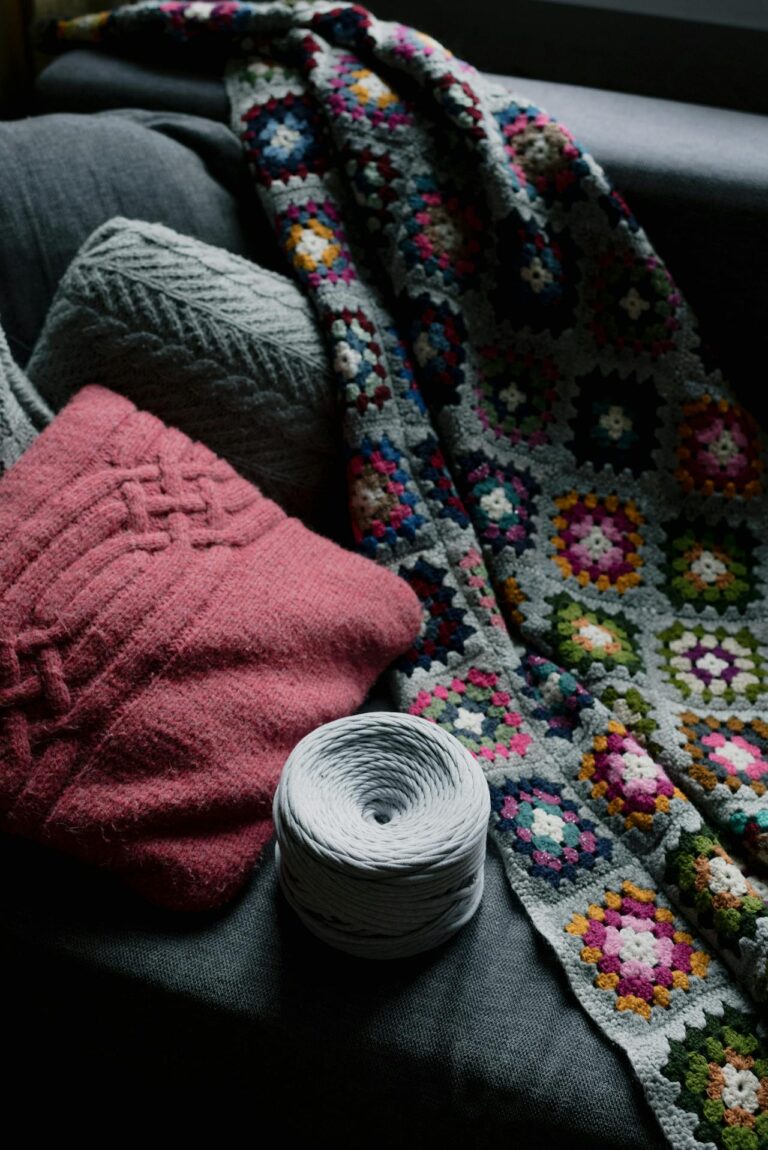
The appeal of a granny square sweater goes beyond nostalgia. The modular construction offers practical advantages that continuous-garment patterns cannot match. First, if you make a mistake on one square, you only need to redo that single square — not an entire row or panel. Second, you can try on the sweater as you build it by laying out your squares on a flat surface and adjusting the layout before committing to seams. Third, the color possibilities are essentially infinite. You can use a different color for every square, create gradient panels, or stick to a refined two-tone palette — the choice is yours, and it is easy to change your mind mid-project.
Garment construction can feel intimidating, but a granny square sweater breaks the process into manageable, low-stakes steps. If you have already made a granny square blanket or a granny square bag, you have all the fundamental skills needed to make a sweater. The only new techniques are garment assembly — joining panels, creating armholes, and finishing necklines — and these are straightforward to learn. For more on garment fitting, our crochet sweater pattern guide covers general sizing and construction principles that apply to granny square garments.
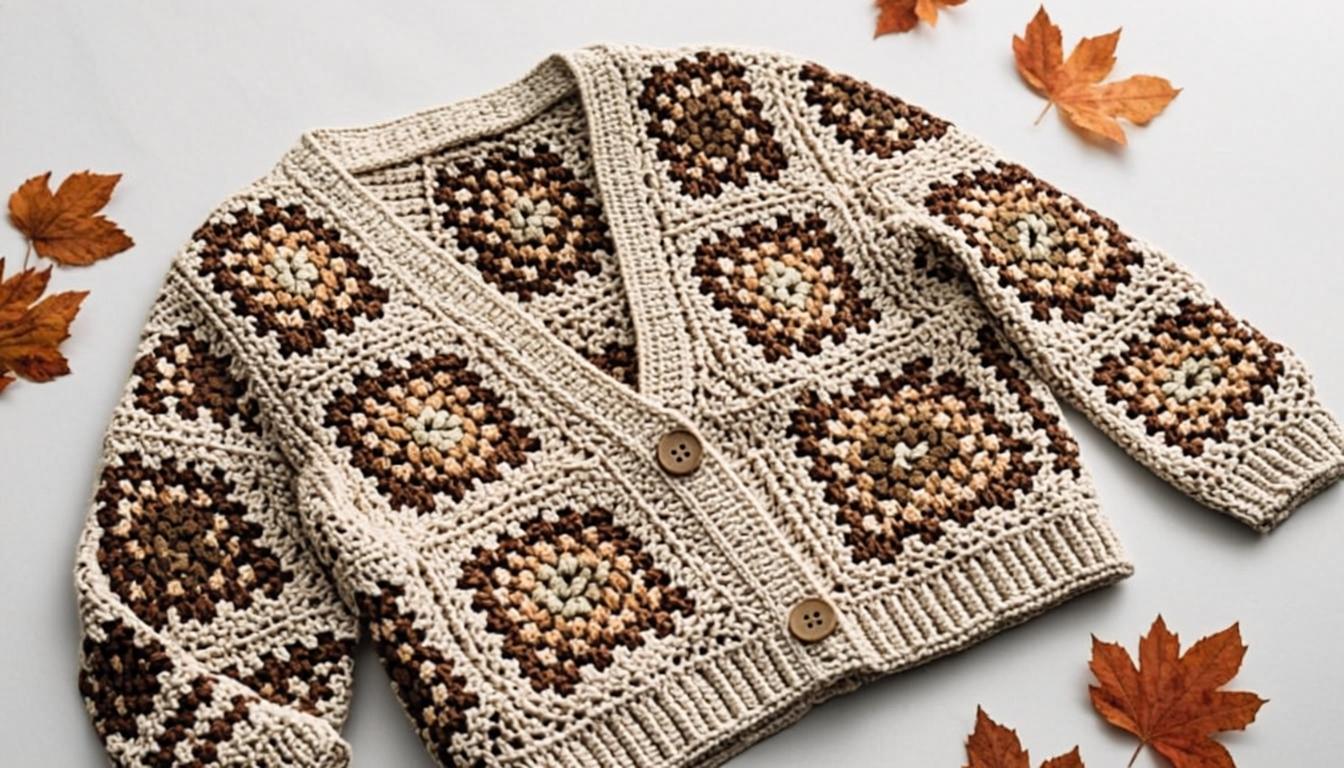
Understanding Granny Square Sweater Construction
Every granny square sweater follows the same basic construction process:
- Make your granny squares: Crochet the required number of squares for each panel. Most patterns call for specific arrangements — for example, 4 squares across and 5 squares tall for the back panel.
- Block all squares: Pin each square to its exact finished dimensions and let dry. This is critical for garment construction because uneven squares create uneven panels.
- Join squares into panels: Use whip stitch, slip stitch, or JAYG to join squares into front panel, back panel, and two sleeve panels.
- Seam the garment: Join the shoulder seams (front to back at the top), then attach sleeves to the body at the armholes, then seam the sleeve edges and side seams in one continuous seam from wrist to hem.
- Add finishing: Work an edging round around the neckline, front opening (for cardigans), and cuffs. Add buttons, pockets, or other embellishments as desired.
7 Free Granny Square Sweater Patterns
Pattern 1: Classic Granny Square Cardigan
This is the most popular granny square sweater style — an open-front cardigan with set-in sleeves. Make 24 to 36 standard granny squares (4 to 5 rounds each) and arrange them into two rectangular panels for the front (split down the middle for the button band opening) and one panel for the back. Make two smaller rectangular panels for the sleeves. Seam shoulders, attach sleeves, and close the side and underarm seams. Add a row of single crochet around the front opening and neckline for a clean finish, then sew on large wooden buttons. This cardigan works beautifully in autumnal colors — burnt orange, forest green, and cream — and can be worn over dresses, tanks, or basic tees.
Pattern 2: Granny Square Crop Top
For a trendy, summer-friendly garment, make a cropped granny square sweater using smaller 3-round squares. Arrange 3 squares across and 3 squares down for each front and back panel (18 squares total). This creates a cropped, boxy top that hits at the natural waist. Use DK weight cotton yarn for a cool, breathable fabric. Leave the sides partially open for a breezy look, or seam them closed for more coverage. Add thin strap ties at the shoulders using chain stitches. This quick project uses only 200 to 300 yards of yarn and can be completed in a weekend.
Pattern 3: Oversized Boho Granny Square Pullover
Channel 1970s style with an oversized, drop-shoulder pullover made from large 5-round granny squares. Use 30 to 40 squares arranged in wide panels that create a deliberately roomy fit. The drop-shoulder construction means the sleeve panels are simply extensions of the body panels — no armhole shaping required, which makes this one of the easiest granny square sweater patterns to assemble. Use earthy, muted tones or a warm sunset palette. The oversized silhouette is flattering on all body types and looks effortless layered over a turtleneck or tank top.
Pattern 4: Granny Square Vest
A sleeveless granny square sweater vest is the fastest garment pattern in this collection because you skip the sleeves entirely. Make a front panel and back panel from 12 to 20 joined squares, seam the shoulders, and add a V-neck or scoop neckline by shaping the top edge with decreases. The vest is perfect for transitional weather — wear it over a long-sleeve tee in spring, or over a turtleneck in fall. It is also an excellent first garment project for crocheters who are nervous about sleeves.
Pattern 5: Granny Square Bolero
A bolero is a short, cropped cardigan that covers just the shoulders and upper arms. Make 12 to 16 granny squares and arrange them into two small rectangular panels that drape over the shoulders. Seam the center back and attach the panels across the upper chest with a few connecting squares or a chain-stitch bridge. The bolero adds a layer of warmth without bulk and pairs beautifully with sleeveless dresses and camisoles. Use the solid granny square variation for a denser, warmer fabric that provides more insulation than the standard openwork version.
Pattern 6: Color Block Granny Square Cardigan
Design a bold statement granny square sweater by dividing each panel into distinct color blocks. Work the bottom row of squares in Color A, the middle rows in Color B, and the top row in Color C. The horizontal color bands create a striking visual effect that draws the eye upward. Use high-contrast colors for maximum impact — navy and cream, charcoal and coral, or black and mustard. This pattern uses the same construction as the classic cardigan (Pattern 1) but the color planning creates a completely different aesthetic.
Pattern 7: Granny Square Poncho
If a fitted garment feels intimidating, a poncho is the perfect gateway granny square sweater. Make two large rectangular panels (each 3 squares wide by 6 squares tall) and join them at the shoulders only, leaving the sides completely open. The center opening goes over your head, and the front and back drape down like a shawl. This is arguably the easiest garment to construct because there are no armholes, no sleeves, and no side seams to worry about. Add fringe to the bottom edge for extra style. A poncho is warm, cozy, and looks stunning over a simple outfit.
Sizing Your Granny Square Sweater
Getting the right fit requires planning before you start. Follow these steps for accurate sizing:
- Make a gauge swatch: Crochet one complete granny square using the yarn and hook you plan to use. Measure it precisely — width and height.
- Calculate your grid: Divide your desired body measurements (chest circumference for a sweater, or width for a cardigan front panel) by your single square width. Round to the nearest whole number.
- Account for seam allowance: Subtract about half an inch per seam from your total measurements, since seaming takes up space.
- Add ease: Add 2 to 4 inches of positive ease for a standard fit, or 6 to 8 inches for an oversized fit. Subtract 0 to 2 inches for a fitted look.
- Make a test panel: Before committing to the full project, join 3 to 4 squares in a strip, measure the actual seamed dimensions, and compare to your calculations. Adjust if needed.
Frequently Asked Questions
Is a granny square sweater hard to make?
Not particularly — if you can make granny squares and join them, you can make a granny square sweater. The construction is straightforward: make squares, join them into panels, and seam the panels together. The main challenges are getting the sizing right (solved by making a gauge swatch) and working neatly during assembly (solved by blocking your squares first). A cardigan or vest is the best starting pattern because they have the simplest shapes.
KnotToYarn
Subscribe to KnotToYarn!
Get the best free crochet patterns, tutorials & tips delivered straight to your inbox. Join our growing community!
How many granny squares do I need for a sweater?
A typical granny square sweater cardigan in a medium size requires 24 to 40 squares, depending on the square size and the desired fit. A crop top needs 12 to 20 squares. An oversized pullover can require 30 to 50 squares. Always calculate based on your specific gauge rather than a pattern’s square count, since your tension may produce slightly different square dimensions.
What is the best yarn for a granny square sweater?
Worsted or DK weight acrylic, cotton, or wool-blend yarns are the best choices for a granny square sweater. Acrylic is affordable and soft, cotton provides excellent drape for warm-weather garments, and wool blends add warmth for winter pieces. Use the same type of yarn throughout the entire sweater for consistent gauge and drape across all panels.
How do I care for a granny square sweater?
Check your yarn label for specific care instructions. Acrylic granny square sweaters can usually be machine washed on a gentle cycle in cold water and laid flat to dry. Cotton and wool garments should be hand washed in cool water with a gentle detergent and reshaped while damp. Always dry your sweater flat on a towel — hanging a wet sweater stretches it out of shape permanently. Store folded, never hung.
Can I adjust the length of my granny square sweater?
Yes — this is one of the biggest advantages of the modular construction. To make your granny square sweater longer, simply add another row of squares to the bottom of each panel before assembling. To make it shorter, reduce the number of square rows. You can also add length after assembly by working rows of double crochet or single crochet directly onto the bottom edge of the finished garment.
Helpful resource: Ravelry hosts thousands of granny square sweater patterns with photos, sizing information, and community reviews. Browsing finished projects from other crocheters is one of the best ways to choose a pattern that suits your skill level and style.
Helpful resource: Ravelry hosts thousands of granny square sweater patterns with photos, sizing information, and community reviews. Browsing finished projects from other crocheters is one of the best ways to choose a pattern that suits your skill level and style.