
The double crochet stitch (abbreviated DC) is one of the most popular, versatile crochet stitches. It is taller than the single crochet, which means your projects grow much faster with each row. It is the go-to stitch for blankets, scarves, shawls, and garments.
As an Amazon Associate we earn from qualifying purchases: some supply links in this post are affiliate links, at no extra cost to you.
Tip: Follow the turning-chain instruction in the pattern you are using; whether a chain 3 counts as a stitch is a pattern convention.
What Is the Double Crochet Stitch?
The double crochet stitch, abbreviated DC, is one of the most popular and versatile crochet stitches, used in everything from granny squares to lace patterns. It is taller than both the single crochet and the half double crochet, which means your projects grow much faster with each row. This makes dc the go-to stitch for blankets, scarves, shawls, cowls, and garments where you want a drapey, open fabric.
The double crochet stitch creates a fabric with a nice drape and a slightly open texture. It works up quickly because each stitch adds more height than shorter stitches. For beginners, this stitch is usually the second or third one learned after the chain and single crochet. Once you master it, you will find it in countless patterns across every category of crochet.
In US terminology, this stitch is called “dc.” In UK terminology, it is called “treble crochet.” Always verify which terminology your pattern uses before you start, as the two systems use different names for the same stitches.
How to Double Crochet: Step-by-Step?
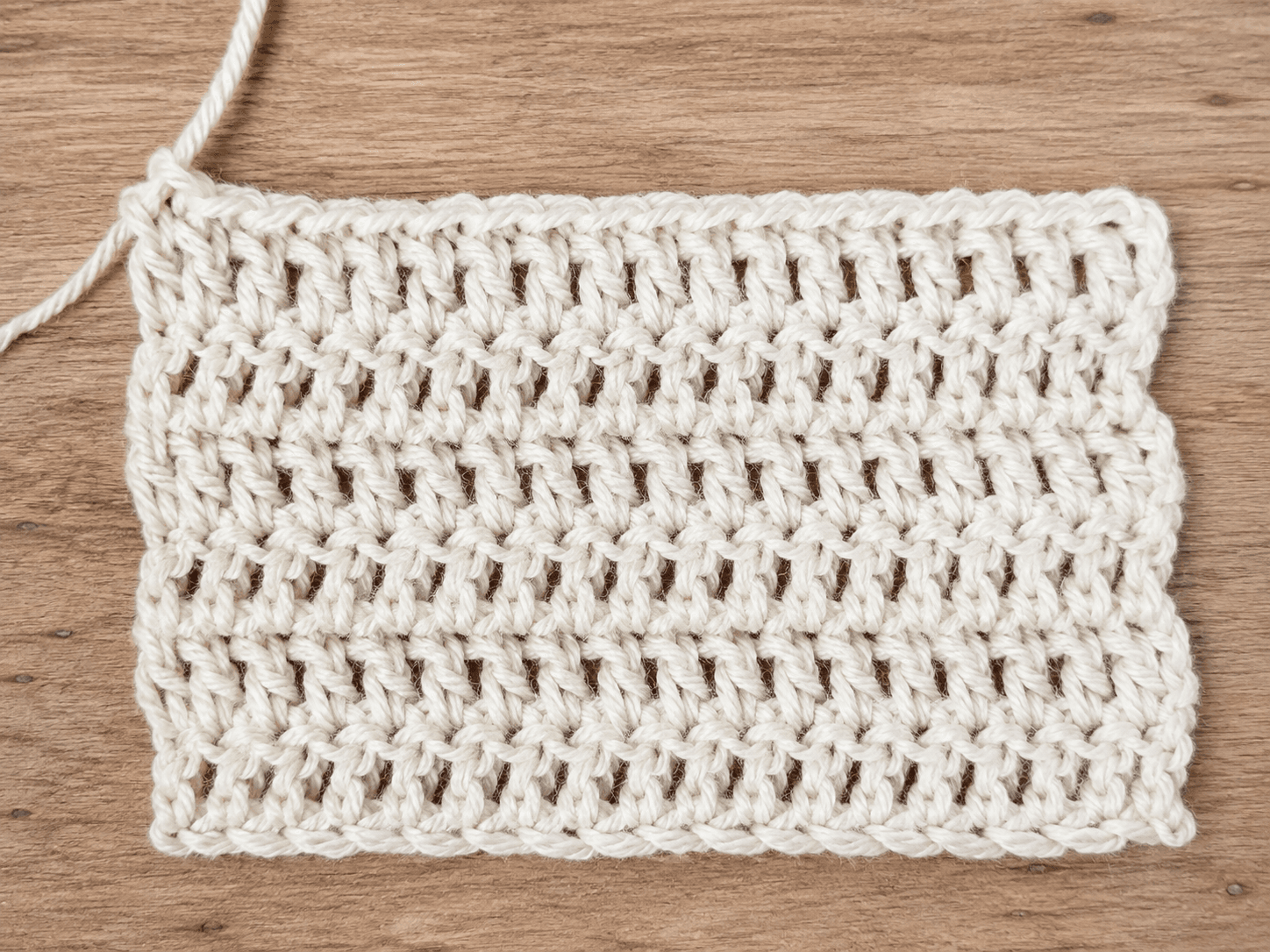
The DC has one extra step compared to the single crochet: you yarn over BEFORE inserting your hook. This is what gives the stitch its extra height. Follow these eight steps carefully.
Step 1, Yarn over. Wrap the yarn over your hook from back to front before you do anything else. This is the key difference from single crochet, in DC, the yarn over comes first.
Step 2, Insert your hook. Insert your hook into the fourth chain from your hook. The “fourth chain” means you skip the first three chain stitches (for this practice swatch, treat these three chains as the turning chain and first dc in the stitch count) and insert into the fourth one. Go under the top two loops of the chain stitch.
Step 3, Yarn over. Wrap the yarn over your hook again, just like in step 1.
Step 4, Pull through. Pull the yarn through the chain stitch. You should now have three loops on your hook. This is different from single crochet, where you only had two loops at this point.
Step 5, Yarn over. Wrap the yarn over your hook once more.
Step 6, Pull through two loops. Pull the yarn through the first two loops on your hook (the two closest to the hook tip). You should now have two loops remaining on your hook.
Step 7, Yarn over one last time. Wrap the yarn over your hook again.
Step 8, Pull through the remaining two loops. Pull the yarn through the last two loops on your hook. You should now have only one loop remaining. That completes one dc stitch.
To continue: Repeat steps 1 through 8 in each chain stitch across your foundation chain. At the end of the row, chain 3 and turn your work. In the practice scarf below, the chain 3 is counted as the first dc.
Important note about the turning chain: For the practice scarf below, the chain 3 is counted as the first dc. Other patterns may use a different turning-chain convention; follow that pattern’s written instructions.
Double Crochet Tips for Beginners
- Count your stitches after every row. For the practice scarf below, include the chain 3 in the stitch count. In other patterns, use the stated turning-chain convention. If your foundation row has 20 chains, you should have 20 stitches at the end of every row (including the chain-3).
- Watch for gaps at row ends. If your edges are wavy or have visible gaps, you may be placing your last stitch in the wrong place. At the end of each row, make sure you work a DC into the top of the chain-3 from the previous row.
- Keep your loops even. The double crochet has more loops to manage than single crochet. Try to keep your yarn tension consistent so all three loops on your hook are the same size.
- Use a larger hook for drape. If your double crochet fabric feels too stiff, try going up one hook size. A larger hook creates a looser, more flowing fabric that is ideal for scarves and shawls.
- Practice the rhythm. Double crochet follows a “YO, insert, YO, pull through, YO, pull through 2, YO, pull through 2” rhythm. Once you memorize this sequence, you will work much faster.
Free Double Crochet Practice
This scarf is one of the best projects for practicing double crochet, straightforward, practical, and a great confidence-builder while you make something you can actually wear. It is well suited to your first DC project.
Beginner dc Scarf
Yarn: Worsted weight yarn (any color)
Hook: 5.5 mm (I-9)
Abbreviations: CH = chain, DC = dc
Instructions:
Chain 19.
Row 1: DC in the 4th chain from hook and in each chain across. Turn. (17 DC, the first 3 chains count as 1 DC)
Row 2: Chain 3 (counts as first DC). DC in the next stitch and in each stitch across, working the last DC into the top of the chain-3 from the previous row. Turn. (17 DC)
Rows 3-120: Repeat Row 2.
Fasten off, leaving a 6-inch tail. Weave in both ends with your tapestry needle.
For a wider scarf, work a swatch and calculate a starting chain using the same turning-chain convention. For a shorter scarf, work fewer rows. You can also add fringe to both ends by cutting 8-inch yarn pieces, folding them in half, and pulling the loop through the end stitches with your hook.
Looking for more projects? Visit our free crochet patterns collection for dozens of beginner-friendly designs using the DC stitch and other stitches.
You Might Also Like
Related Tutorials
Compare this stitch directly to single crochet in our side-by-side guide (single vs double crochet).