
Two techniques split this list roughly in half: spiderwebs surface-crocheted or embroidered flat onto coasters and doilies, and spiders built as proper three-dimensional amigurumi toys. Worth deciding which camp you’re in before picking a pattern, since the skills barely overlap.
The amigurumi spiders need safety eyes and fiberfill; the flat coaster and web versions need almost nothing beyond a hook and cotton yarn.
Spider and web patterns to explore
1. Spiderweb Coasters
Carmen’s spiderweb coasters are made of a 5 inch round coaster base plus a separate eight-spoke spiderweb motif with picot edging that you sew or glue to the center. You only need to know how to chain, single crochet and double crochet. She used DK weight cotton, which keeps it practical for actual coasters, and suggests purple and green instead of orange and black if you want something less literal. She says when she gave them to friends, they squealed with delight.
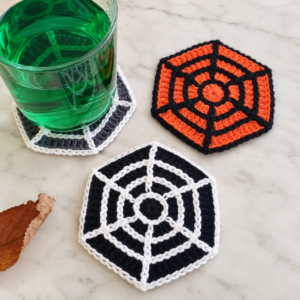
2. Spiderweb Halloween Coasters
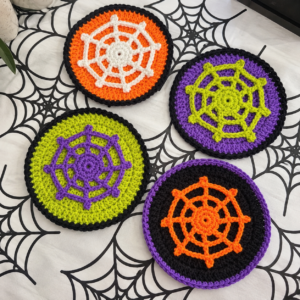
Raffaella’s spiderweb coasters are made from a solid hexagon with no gaps, with the web surface-crocheted on top in slip stitch in a contrasting color, and there is a video tutorial. She used Paintbox Cotton DK (50 g, 137 yards) and a small C hook, though any yarn that meets the gauge works. It finishes smaller than the pattern above, at about 3.5 inches. She suggests making extra to give as little party souvenirs, and an ad-free PDF is sold separately.
3. Amigurumi Spider
Kimberly Arenas’ spider is a 6-inch stuffed spider with eight crocheted legs. She made two spiders within just a few hours, so it suits craft fairs and Halloween markets. She suggests black yarn for a classic spooky look or bold colors for kid-friendly versions, and embellishments like tiny hats, bows or glow-in-the-dark yarn. Note that chunky yarn makes a much larger spider, while DK makes a smaller one.
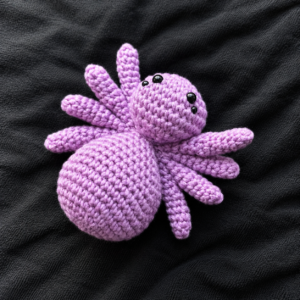
4. Jelly Bean Spider
Darling Maple Designs’ Jelly Bean Spider is a no-sew, cute-rather-than-creepy amigurumi with eight legs, made in super bulky yarn. You can whip up several in a few hours for decorating or gifting to friends who love the goth aesthetic. The page also explains how to make a simple spider web from white or grey yarn, since thinner yarns give the best delicate, tangled look. The pattern is also on Ravelry and Etsy.
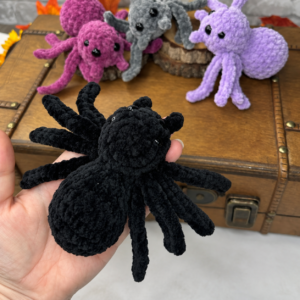
5. Black Spider Keychain
@canuckcreativity’s black spider keychain, published on Amigurumiday, uses green yarn around the edges of the black eyes so they are more visible. The eyes are inserted between rows 7 and 8, 3 to 4 stitches apart, and you can add a color detail around each eye before attaching the keychain. The page notes the legs are one of the interesting details of the toy. It is worked in the round from a magic ring, using front and back loop rounds.
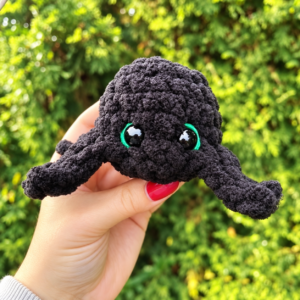
6. Spooky Crochet Spider
Lovable Loops’ spider is rated for advanced beginners and worked in worsted weight yarn with an H-8 (5 mm) hook, a yarn needle and scissors. It is a spooky-cute spider with big eyes, and the page includes a video tutorial. You join each round with a slip stitch to the first stitch of that round, and repeat the instructions between asterisks for the rest of the round.
7. Spider Pocket Pet
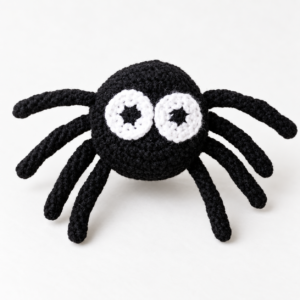
Joey Diehl’s Spider Pocket Pet uses one color of medium (4) weight yarn (Red Heart Super Saver in Tea Leaf), 10 mm black safety eyes and an H-8 (5 mm) hook. The finished spider is about 4.25 inches wide and 2.5 inches deep, and gauge is 18 single crochets by 21 rows over 4 inches. You can make it larger or smaller by changing yarn weight or hook size. It was published in October 2024 and updated in May 2026.
8. Amigurumi Spider
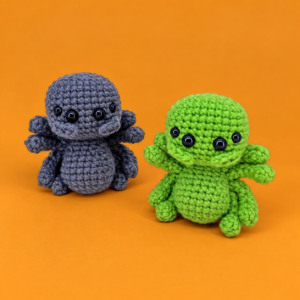
Krazy Kabbage’s spider is a no-sew, one-piece build with legs crocheted directly into the body. She says her earlier spiders started as a squashed ball with legs crocheted on afterwards, so she looked for a better way: she used an inverted popcorn stitch, moved the legs along and made them slightly longer. When a preschooler complained that the spider had no eyes, she tried color changes for eyes but did not like the look, so the spiders are solid-colored.
9. Spider Web
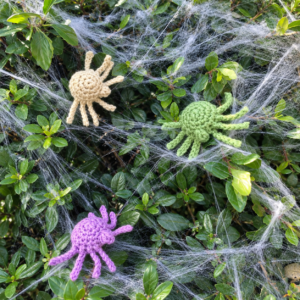
Tonya Bush’s spider web is a beginner-friendly design that grew out of the spider appliqué in her Black Cat Towel Topper. She says she made several web versions over time and this one is the latest. She plans to make a giant web with several colored spider appliqués that the grandkids can play with, and suggests using several webs as Halloween decorations.
10. Spiderweb Doily
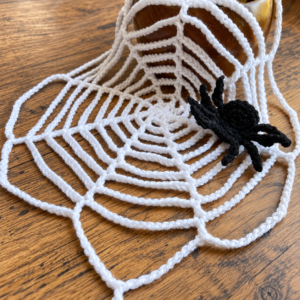
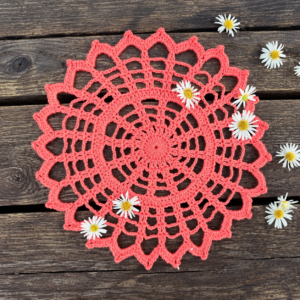
Kristine’s spiderweb doily is worked in fingering weight cotton (size 1 super fine) and measures about 26 cm (10.2 inches) across. It is rated easy to intermediate, and the page has both a video tutorial and the written pattern. You need a small crochet hook, scissors and a yarn needle or latch hook for weaving in ends. It is a real lace doily, closer to traditional doily making than most Halloween decor. It was posted in 2018.
11. Spider Web
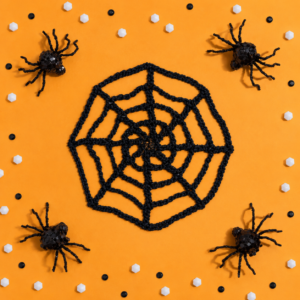
Janine’s Craft Fix spider web pattern can be made in any size, and the page has a 10-minute video tutorial with timestamps so you can skip straight to the parts you need. It is part of her Halloween garland crochet motifs collection, and it also works alone as a hanging decoration if you don’t want a bunting.
12. Spiderweb Bunting
Delia’s spiderweb bunting uses worsted weight (category 4) cotton yarn and a 4.5 mm hook, about 45 g or 75 yards of black Loops & Threads for the bunting. Each web is worked in arched rows with triple crochet, and if you have never triple crocheted, the video tutorial walks you through it. She suggests optional spray starch and an iron to shape the webs. The finished bunting is about 5.5 feet long, and she says she has a twisted fixation with the cute-ish kind of spiders.